
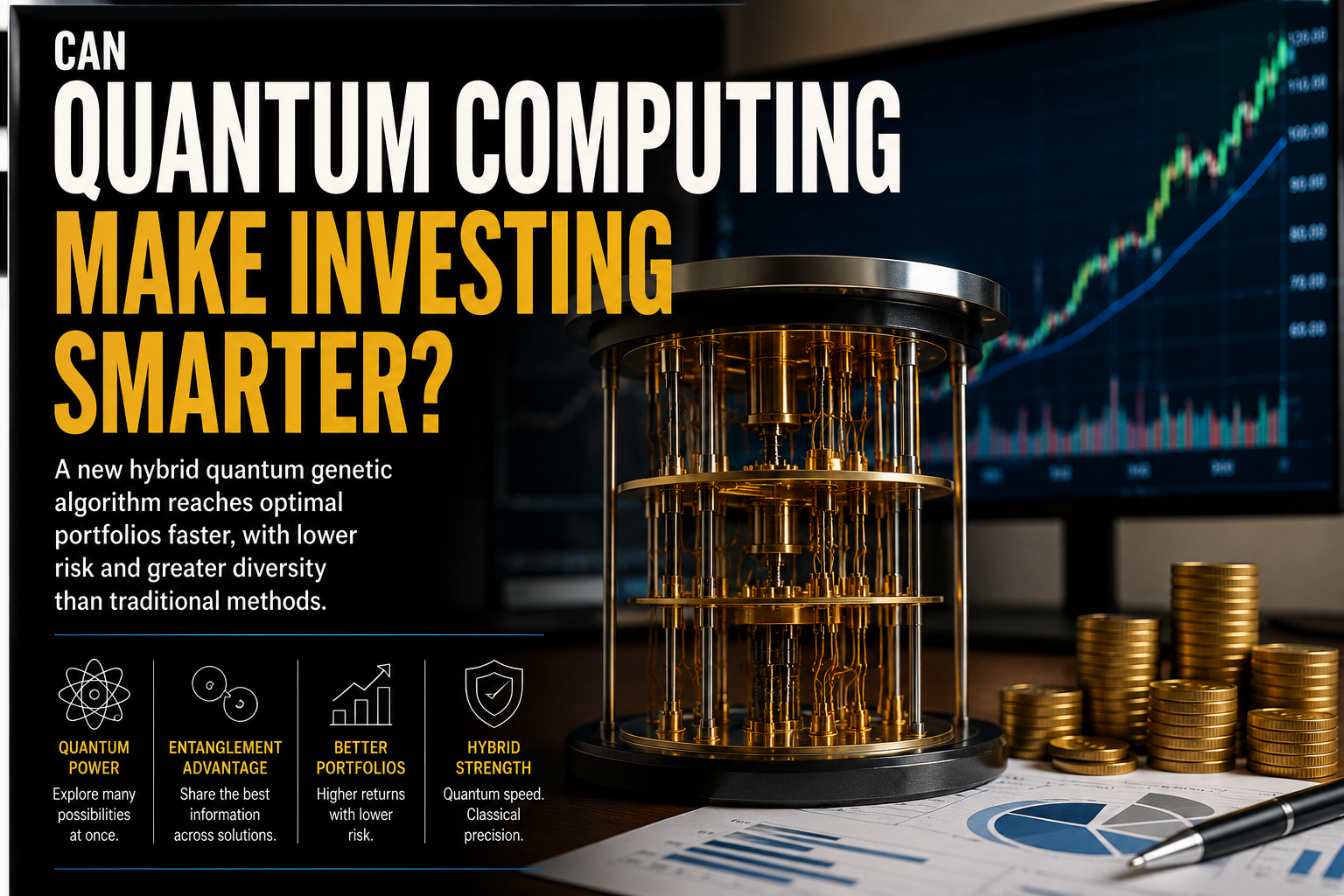
Can Quantum Computing Make Investing Smarter? How Hybrid Quantum Genetic Algorithms Improve Portfolio Optimization
Introduction
Portfolio optimization has been a cornerstone of financial decision-making for decades. Every investor, whether an individual managing personal savings or a large financial institution overseeing billions of dollars in assets, faces the same challenge: how to maximize returns while minimizing risk. Although this objective sounds straightforward, finding the best combination of investments quickly becomes an extraordinarily difficult computational problem.
As the number of available assets increases, the number of possible portfolio combinations grows exponentially. Even modern supercomputers cannot exhaustively evaluate every possible combination within a reasonable time for large financial markets. This challenge has driven researchers to develop increasingly sophisticated optimization techniques capable of searching massive solution spaces efficiently.
A recent study proposes a Hybrid Quantum Genetic Algorithm (HQGA), which combines the strengths of classical optimization with the unique capabilities of quantum computing. Rather than replacing classical computers, the proposed approach allows quantum and classical processors to work together, producing better optimization results while reducing computational effort. The research represents another important step toward practical quantum advantage in real-world financial applications.
Key Ideas
Portfolio optimization is fundamentally an optimization problem in which multiple objectives must be balanced simultaneously. Investors seek higher returns, lower risk, sufficient diversification, liquidity requirements, regulatory constraints, and transaction cost considerations. Improving one objective often negatively affects another, making the search for an optimal portfolio highly complex.
Traditional optimization techniques often become inefficient as the problem size increases. Among the most successful heuristic approaches is the Genetic Algorithm (GA), which mimics biological evolution by repeatedly selecting, combining, and mutating candidate solutions until increasingly better portfolios emerge. While highly effective, Genetic Algorithms suffer from a well-known limitation called Premature Convergence, where the population loses diversity too quickly and becomes trapped around locally optimal solutions.
The proposed Hybrid Quantum Genetic Algorithm introduces quantum mechanical principles into the optimization process. Instead of relying entirely on classical computation, it employs quantum phenomena such as Superposition and Entanglement to generate and evolve candidate solutions more efficiently. The algorithm maintains greater diversity throughout the optimization process, allowing it to continue exploring promising regions of the search space rather than converging too early.
Experimental results demonstrate that the hybrid approach consistently requires fewer computational evaluations while reaching higher-quality portfolio solutions. This suggests that quantum-assisted optimization may become an increasingly valuable tool for solving complex financial problems as quantum hardware continues to improve.
Research Context
Optimization problems extend far beyond financial markets. Similar mathematical challenges appear in transportation systems, airline scheduling, supply chain management, manufacturing, robotics, telecommunications, energy distribution, healthcare, and artificial intelligence. Across all of these disciplines, researchers seek algorithms capable of identifying near-optimal solutions within practical time limits.
Evolutionary algorithms such as Genetic Algorithms, Particle Swarm Optimization, Ant Colony Optimization, and Simulated Annealing have been widely adopted because they provide efficient approximations without requiring exhaustive searches. However, these methods often struggle with maintaining exploration as optimization progresses, particularly when navigating extremely large and complex search spaces.
Quantum computing has emerged as a promising approach for addressing these limitations. During the current Noisy Intermediate-Scale Quantum (NISQ) era, researchers are increasingly focusing on hybrid quantum-classical algorithms that leverage today's quantum processors without requiring fully fault-tolerant quantum computers. Hybrid optimization algorithms have become one of the most active areas of quantum computing research because they offer practical applications that can be explored using existing hardware.
The Hybrid Quantum Genetic Algorithm presented in this study contributes to this growing field by demonstrating how quantum principles can improve one of the most widely used optimization techniques in computational finance.
Why It Matters
The importance of this research extends well beyond portfolio optimization. Every industry faces optimization problems involving thousands or even millions of possible decisions. Whether designing more efficient transportation networks, scheduling manufacturing operations, optimizing electrical power grids, training machine learning models, or discovering new pharmaceutical compounds, organizations constantly search for better algorithms capable of making more intelligent decisions.
By preserving solution diversity and avoiding premature convergence, Hybrid Quantum Genetic Algorithms demonstrate the potential to improve optimization quality while reducing computational costs. Even modest improvements can translate into significant economic benefits when optimization algorithms are executed millions of times in large-scale industrial applications.
Equally important, this research demonstrates that quantum computing is transitioning from theoretical promise toward practical utility. Instead of waiting for large-scale fault-tolerant quantum computers, researchers are already discovering ways to integrate today's quantum processors into real computational workflows. This hybrid approach represents one of the most realistic paths toward widespread quantum adoption over the coming decade.
Open Questions
Although the reported results are encouraging, several important questions remain unanswered. How effectively will Hybrid Quantum Genetic Algorithms scale when optimizing portfolios containing thousands of financial assets instead of relatively modest benchmark datasets? Will future generations of quantum hardware provide sufficient computational improvements to justify deployment in commercial financial systems?
Researchers are also exploring whether similar hybrid optimization techniques can outperform classical algorithms across other scientific and industrial domains. Applications in logistics, engineering design, pharmaceutical discovery, climate modeling, and artificial intelligence all present promising opportunities for hybrid quantum optimization.
Another important question concerns the evolution of quantum hardware itself. As fault-tolerant quantum computers become available, will hybrid algorithms continue to dominate, or will fully quantum optimization algorithms eventually replace them? The answer will likely shape the future direction of quantum computing research for years to come.
While these questions remain open, this study provides strong evidence that hybrid quantum-classical computing is already becoming a practical tool for solving some of the world's most computationally challenging optimization problems, bringing quantum computing one step closer to delivering measurable value across real-world industries.


