
Why Tantalum Is Becoming the Material of Choice for Superconducting Quantum Computers
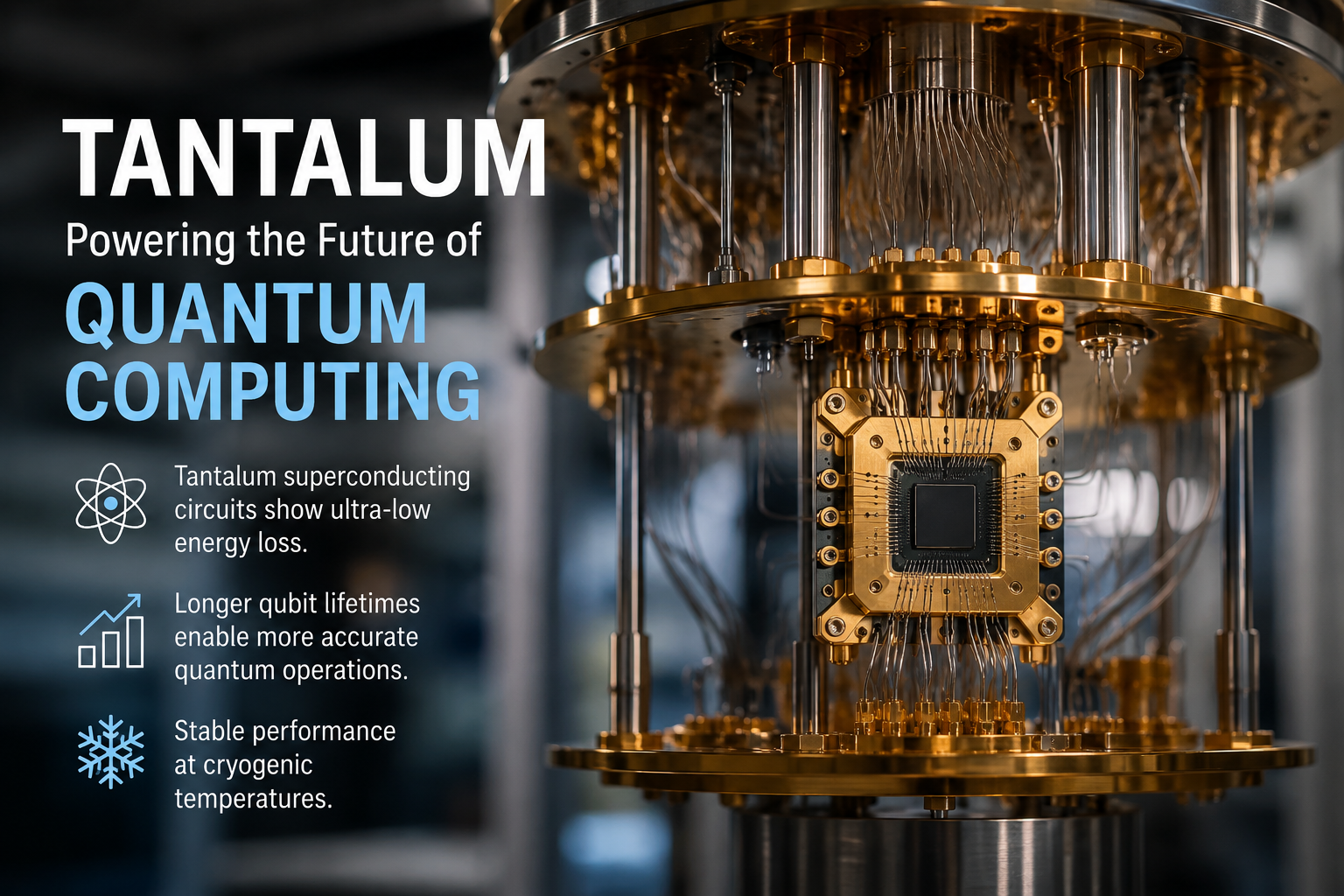
Quantum computing has made remarkable progress over the past decade, but building reliable quantum hardware remains one of its greatest challenges. While most attention focuses on quantum algorithms and increasing the number of qubits, the materials used to fabricate superconducting circuits are equally important. Recent research has shown that tantalum could outperform traditional superconducting materials by reducing energy loss, extending qubit lifetimes, and improving overall quantum processor performance, making it one of the most promising materials for the next generation of quantum computers.
Key Ideas
* Tantalum-based superconducting circuits exhibit significantly lower energy losses than many conventional materials.
* Recent experiments have demonstrated qubits with relaxation times exceeding one millisecond and superconducting resonators with quality factors greater than 10 million.
* Controlling tantalum's crystal structure during fabrication remains one of the most important engineering challenges for large-scale quantum processor manufacturing.
Research Context
For many years, aluminum and niobium have been the dominant materials for superconducting quantum processors. However, recent experimental studies have demonstrated that tantalum consistently delivers longer qubit coherence times and lower dielectric losses. Researchers are actively investigating thin-film deposition techniques, substrate preparation, surface treatments, annealing processes, and crystal growth methods to maximize the performance of tantalum-based superconducting devices. These developments have positioned tantalum as one of the most promising materials currently being explored for scalable quantum computing.
Why It Matters
Reducing energy loss is essential for building practical quantum computers. Longer qubit lifetimes allow quantum processors to perform more calculations before errors accumulate, improving computational accuracy and reducing the need for complex error correction. If tantalum can be manufactured consistently at industrial scale, it could play a central role in enabling more reliable, scalable, and fault-tolerant quantum computers for applications ranging from scientific research and chemistry to optimization, artificial intelligence, and cryptography.
Open Questions
Despite its impressive performance, several important questions remain unanswered. Researchers are still working to understand the exact physical mechanisms responsible for tantalum's superior superconducting behavior, how to reliably produce the high-performance alpha crystal phase during large-scale manufacturing, and whether its exceptional laboratory results can be reproduced consistently in commercial quantum processors. Future advances in materials science and fabrication techniques will determine whether tantalum becomes the standard material for next-generation superconducting quantum hardware.


