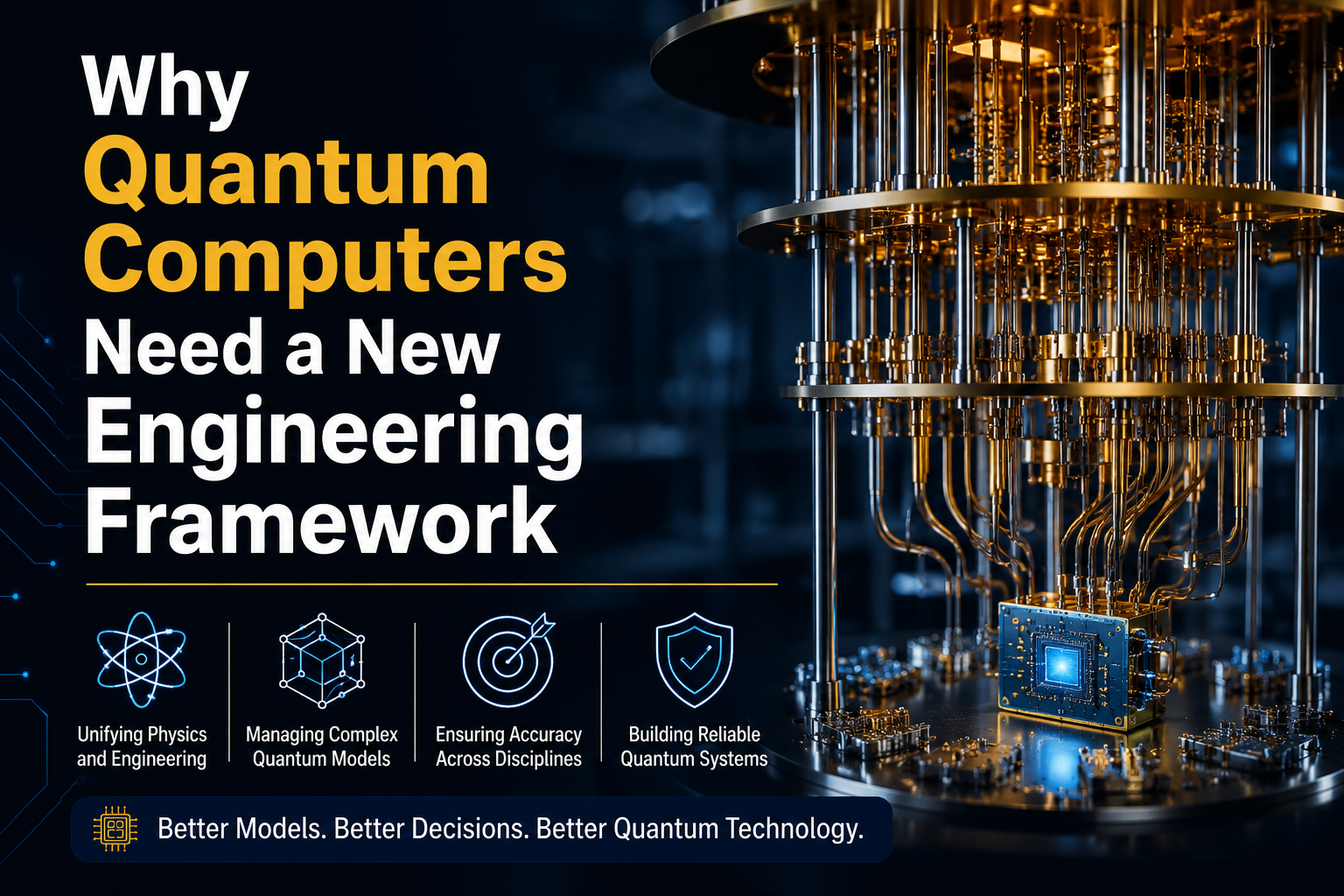
Why Quantum Computers Need a New Engineering Framework
Quantum computing is advancing at an extraordinary pace. Every year, researchers build more powerful quantum processors, improve qubit stability, and develop increasingly sophisticated quantum algorithms. Yet as quantum computers evolve from laboratory prototypes into real engineering systems, a less visible challenge is emerging. Building a reliable quantum computer is no longer just about improving hardware or inventing better algorithms—it is about coordinating the enormous number of engineering models used to design, simulate, verify, and operate these systems.
Today's quantum computers are developed by teams of physicists, hardware engineers, software engineers, control engineers, and systems engineers, each working with specialized models that describe different aspects of the same machine. Ensuring these models remain accurate, synchronized, and physically consistent has become one of the biggest engineering challenges facing the quantum industry. A new research paper introduces the Quantum Systems Model Management Framework (QSysMM), proposing an entirely new way to manage engineered quantum systems while preserving the unique physical properties that make quantum computing possible.
Key Takeaways
* Modern quantum computers are designed using many independent engineering models that must remain synchronized throughout development.
* Traditional model management techniques cannot detect when uniquely quantum properties such as superposition or entanglement are unintentionally lost during model transformations.
* The proposed Quantum Systems Model Management Framework (QSysMM) introduces physics-aware model synchronization that validates both engineering consistency and quantum correctness.
* The framework organizes quantum engineering into four major concerns: ontology, abstraction, composition, and exposure.
* This research provides an important engineering foundation for building reliable, scalable, and trustworthy quantum technologies in the future.
The Context
As quantum technologies mature, the engineering challenges surrounding them are becoming increasingly complex. Early quantum computing research focused primarily on demonstrating quantum phenomena and building functional qubits. Today, researchers are designing complete quantum systems that integrate superconducting circuits, microwave electronics, cryogenic infrastructure, control firmware, quantum software, calibration procedures, error correction, and classical computing resources.
Each engineering discipline involved in this process creates its own model of the system.
A quantum physicist describes wavefunctions, Hamiltonians, decoherence, and quantum states.
A hardware engineer models superconducting circuits, microwave resonators, control electronics, and fabrication constraints.
A quantum software engineer works with logical qubits, quantum gates, compilers, and execution pipelines.
A systems engineer focuses on interfaces, requirements, verification, system architecture, and overall integration.
Although every team is describing the same quantum computer, each model captures different information using different mathematical representations and engineering languages.
The challenge is ensuring that all of these models remain consistent throughout the lifetime of the project. A small change in one discipline can affect many others. Without reliable synchronization, engineers may unknowingly base important design decisions on outdated or physically incorrect information.
Current model-based systems engineering techniques have been highly successful in industries such as aerospace, automotive engineering, and defense. However, these approaches were designed for classical systems. Quantum technologies introduce physical behaviors that simply do not exist in classical engineering, requiring an entirely new generation of engineering methodologies.
The Main Idea
The researchers propose the Quantum Systems Model Management Framework (QSysMM), a comprehensive engineering framework designed specifically for quantum technologies.
Rather than replacing existing engineering tools, QSysMM creates a common management layer that connects all engineering models into a synchronized digital ecosystem.
Its central idea is simple but powerful: every engineering model should remain both structurally consistent and physically faithful to the underlying quantum system.
The framework organizes this process through four complementary engineering concerns.
Ontological Concern
The first concern defines what each model actually represents.
Some models describe theoretical concepts, such as logical qubits, quantum algorithms, or fault-tolerance thresholds.
Other models describe physical implementations, including fabricated superconducting devices, microwave control systems, calibration procedures, firmware, and measured device characteristics.
QSysMM explicitly connects theoretical models with their real-world implementations, allowing engineers to trace every system property from abstract design to physical hardware.
Abstraction Concern
Engineering always requires simplification.
Complex physical systems must often be reduced into simpler models that are easier to analyze or simulate.
For classical systems this process is usually straightforward.
Quantum systems are fundamentally different.
Simplifying a quantum model may accidentally remove essential quantum properties including superposition, entanglement, quantum coherence, or correlated noise, while every traditional engineering validation still reports that the model is correct.
To prevent this, QSysMM introduces validation contracts.
Every transformation between models must explicitly specify:
* Which quantum properties are preserved.
* Which information has been discarded.
* Under which physical assumptions the simplified model remains valid.
* How engineers can verify that these assumptions continue to hold.
This makes model simplification transparent and scientifically verifiable.
Composition Concern
Large-scale quantum computers consist of many interconnected subsystems.
These include quantum processors, control electronics, cryogenic systems, measurement hardware, classical computing infrastructure, and quantum software.
Traditional engineering assumes that subsystems can often be analyzed independently before combining them into a larger system.
Quantum mechanics breaks this assumption.
Through entanglement, multiple quantum components may behave as one inseparable system.
QSysMM ensures that engineering models preserve these physical relationships during system integration rather than treating quantum components as independent when they are not.
Exposure Concern
Different stakeholders require different levels of technical detail.
A quantum physicist may need access to complete mathematical models.
A hardware engineer may only require device parameters.
A systems engineer may only need verification metrics.
Project managers may only need performance indicators.
QSysMM allows every stakeholder to view the information appropriate for their role while preserving complete traceability to the original engineering models and the physical assumptions behind every reported result.
Why It Matters
The importance of this work extends far beyond a single engineering framework.
Future quantum computers will contain thousands—and eventually millions—of physical qubits, supported by increasingly sophisticated electronics, software, networking infrastructure, calibration systems, and error correction mechanisms.
Managing this level of complexity will require engineering methodologies that are as advanced as the quantum hardware itself.
Without reliable model synchronization, different engineering teams could unknowingly work from inconsistent system descriptions, introducing errors that remain hidden until late stages of development or even deployment.
By introducing physics-aware model management, QSysMM offers a pathway toward more reliable quantum engineering workflows.
The framework could improve collaboration across disciplines, strengthen system verification, reduce engineering risks, and support the development of digital engineering environments for future quantum technologies.
Its concepts are also expected to extend beyond quantum computing into quantum communication, quantum sensing, quantum networking, and other emerging quantum technologies that combine multiple engineering domains.
What To Watch Next
Although QSysMM establishes a strong conceptual foundation, much work remains before it becomes an industrial engineering standard.
Future research will focus on developing the proposed Quantum Systems Modeling Language (QSysML), implementing automated synchronization between heterogeneous engineering tools, and integrating the framework into SysML v2 development environments.
Researchers must also develop practical methods for validating quantum-specific engineering contracts, particularly when dealing with large entangled systems whose physical properties are computationally difficult to verify.
Another important direction is extending the framework beyond superconducting quantum computers to support trapped-ion systems, photonic quantum computers, neutral atoms, quantum communication networks, and quantum sensing platforms.
If successful, QSysMM could become one of the core engineering foundations that enable reliable, scalable, and commercially deployable quantum technologies.