
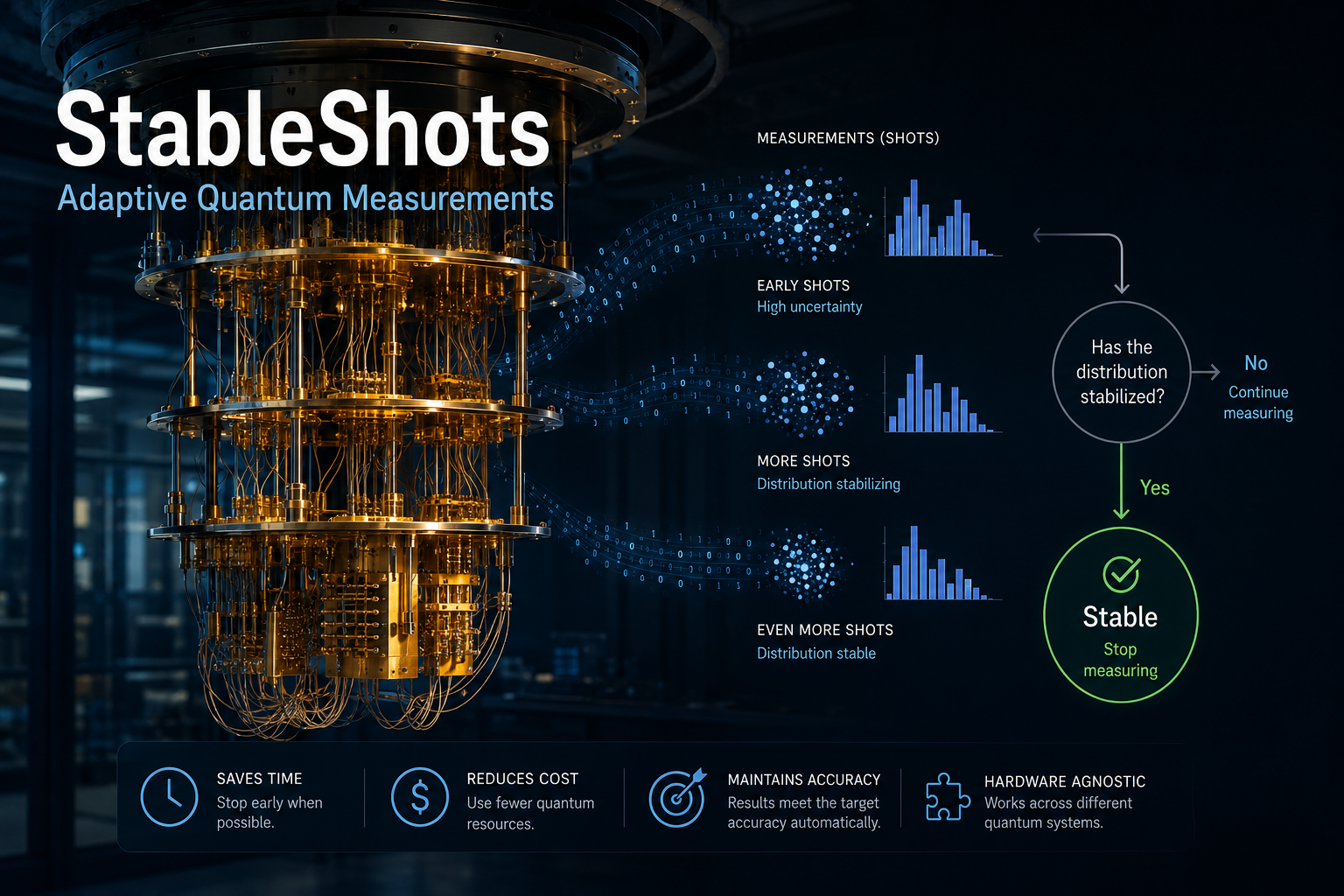
How StableShots Lets Quantum Computers Decide When to Stop Measuring
Quantum computers do not produce deterministic answers like classical computers. Instead, each execution of a quantum circuit generates one possible outcome according to the circuit's underlying probability distribution. Because of this probabilistic behavior, a quantum circuit must be executed repeatedly, with each execution known as a shot. Collectively, these shots allow researchers to estimate the circuit's true output distribution.
Choosing the correct number of shots has long been a practical challenge. Too few measurements can produce unreliable statistical estimates, while too many waste valuable quantum computing resources, increase execution time, and raise operational costs. Since quantum hardware remains scarce and expensive, selecting an appropriate shot count is an important optimization problem.
StableShots addresses this challenge by replacing the traditional fixed-shot approach with an adaptive measurement strategy.
Key Ideas
- Quantum computers produce probabilistic results, requiring repeated executions called shots to estimate the true output distribution.
- StableShots divides measurements into small batches and continuously evaluates whether the probability distribution has converged.
- The algorithm automatically stops execution when additional measurements provide little new information, improving efficiency while maintaining statistical accuracy.
Research Context
Current quantum computing platforms typically rely on a fixed number of measurement shots selected before execution. While this approach is simple, it often wastes expensive quantum resources or produces insufficient statistical confidence. StableShots introduces an adaptive execution policy based on statistical convergence rather than predetermined measurement counts.
Instead of executing all measurements at once, StableShots performs measurements in small batches. After each batch, it compares the updated probability distribution with the distribution obtained from previous measurements. If the distributions continue to change significantly, additional measurements are performed. If the distributions remain nearly identical over several consecutive batches, the algorithm concludes that the results have stabilized and automatically terminates the measurement process.
To quantify convergence, StableShots uses Total Variation Distance (TVD), a statistical metric that measures the difference between two probability distributions. As the TVD approaches zero, newly collected measurements become increasingly similar to previous observations, indicating that additional shots are unlikely to improve the final estimate.
One of StableShots' strongest advantages is its hardware independence. The algorithm does not require knowledge of the quantum circuit, the quantum processor, or the underlying noise model. Instead, it monitors only the observed measurement results, allowing it to operate across different quantum computing platforms without hardware-specific modifications.
The researchers evaluated StableShots using 180 quantum circuits representing multiple quantum algorithms and circuit sizes, together with simulations of five IBM quantum devices. Across these experiments, StableShots consistently achieved the desired statistical accuracy while requiring an average of approximately 7,650 measurement shots. Conventional fixed-shot approaches often required between 10,000 and 18,000 shots to achieve similar accuracy.
Importantly, StableShots should not be viewed simply as a technique for reducing measurements. Instead, it adapts dynamically to each quantum circuit. Some circuits stabilize quickly and require relatively few measurements, while others naturally require more observations before reliable statistical convergence is reached.
Why It Matters
This work represents an important shift in quantum software engineering. Rather than treating the number of measurements as a fixed parameter selected before execution, StableShots transforms it into an intelligent runtime decision based on real-time statistical evidence.
As quantum computing systems continue to evolve, adaptive execution policies like StableShots are expected to become an increasingly important component of efficient, scalable quantum software. By reducing unnecessary measurements while maintaining statistical confidence, the approach lowers execution costs, improves hardware utilization, and moves quantum computing closer to practical large-scale applications.
Open Questions
- Can adaptive shot allocation become a standard feature of commercial quantum cloud platforms?
- How will StableShots perform on future fault-tolerant quantum computers?
- Can machine learning improve convergence detection beyond classical statistical metrics?
- How can adaptive measurement strategies be combined with quantum error mitigation to further reduce execution costs while preserving accuracy?


