How Quantum Packet Routing Could Build the Future Quantum Internet
For more than fifty years, the Internet has relied on a simple principle: data is divided into packets, and routers decide the best path for each packet until it reaches its destination. This design has enabled everything from web browsing to cloud computing. However, the rise of the Quantum Internet introduces a completely different type of information quantum information which cannot always be transmitted using the same rules that govern classical networks.
Unlike classical bits, quantum states are extremely fragile and obey the laws of quantum mechanics. They cannot simply be copied, stored, or forwarded in the same way as ordinary data. This raises an important question for researchers: should the Quantum Internet replace today's Internet architecture entirely, or can existing networking technologies evolve to support quantum communication?
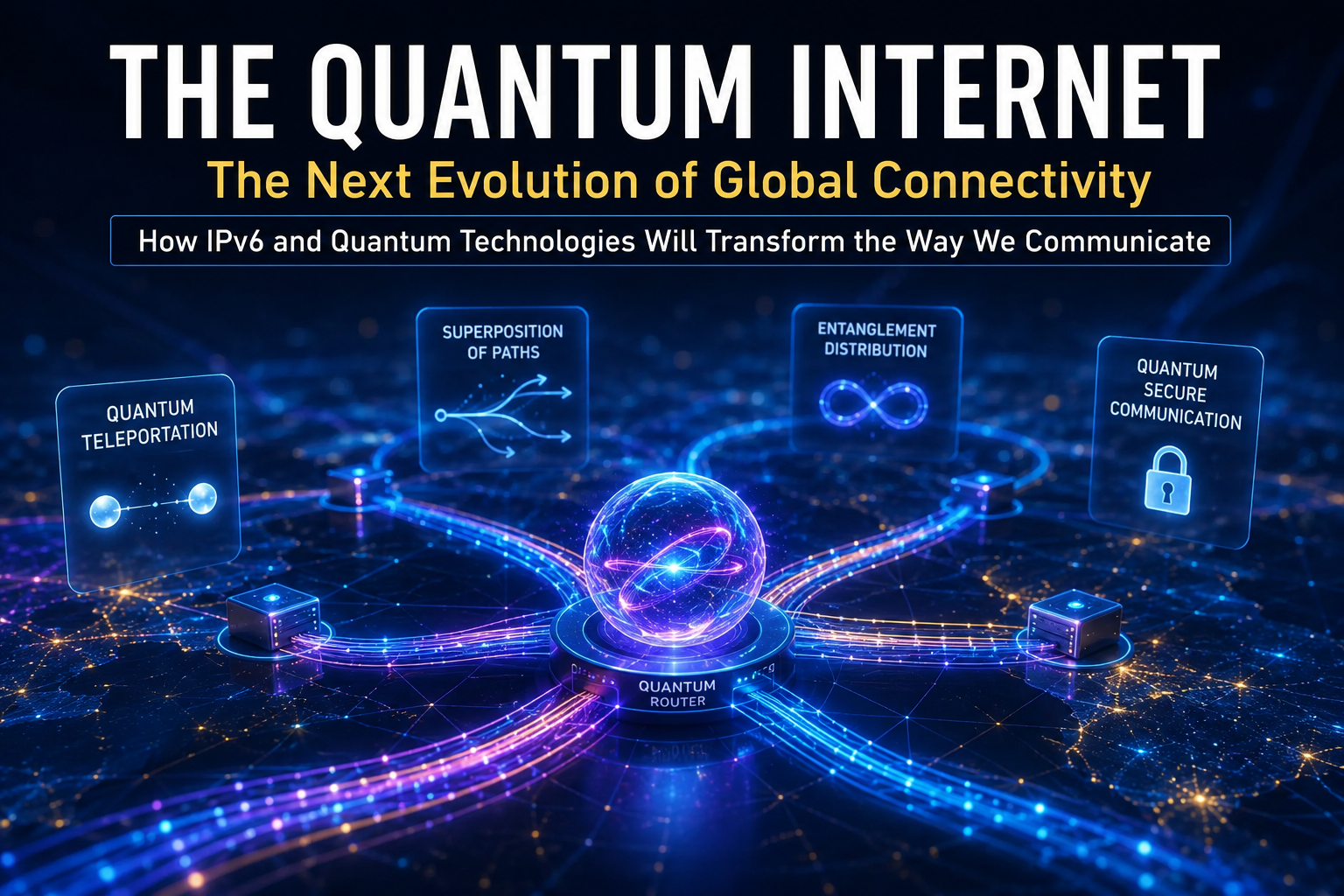
A recent study proposes an elegant answer. Rather than designing a completely new Internet, the researchers suggest extending Internet Protocol Version 6 (IPv6) with new quantum networking capabilities. Their proposal would allow future networks to support quantum teleportation, quantum routing, entanglement distribution, and even quantum superpositions of communication paths while remaining compatible with today's Internet infrastructure.
Key Takeaways
* Researchers propose extending IPv6 instead of replacing the existing Internet architecture for future quantum networks.
* New Quantum Extension Headers would allow routers to understand and process quantum communication instructions.
* Future quantum information could travel through multiple network paths simultaneously using quantum superposition.
* The proposed framework supports advanced quantum networking functions, including quantum teleportation and entanglement distribution.
* Backward compatibility means existing Internet infrastructure could continue operating while quantum technologies are introduced gradually.
* The work provides a realistic engineering roadmap for building the future Quantum Internet without starting from scratch.
The Context
Today's Internet was designed to transport classical information, where every packet follows a single route chosen independently by routers across the network. This model has worked remarkably well for decades because classical data can be copied, buffered, retransmitted, and routed without fundamental physical limitations.
Quantum communication is fundamentally different. Quantum information cannot be copied because of the no-cloning theorem, quantum states are highly sensitive to environmental noise, and many quantum networking tasks rely on shared quantum entanglement instead of direct data transmission.
Over the past several years, researchers have developed quantum repeaters, quantum network stacks, quantum routing algorithms, and quantum communication protocols. However, an important debate remains unresolved: should the Quantum Internet require a completely new networking architecture, or can existing Internet protocols evolve to support quantum technologies?
This paper contributes to that discussion by proposing an evolutionary approach that builds upon IPv6 rather than replacing it.
The Main Idea
The central contribution of this work is the introduction of Quantum Extension Headers for IPv6. These additional packet headers would carry quantum-specific networking instructions while preserving compatibility with existing Internet protocols.
Instead of simply forwarding packets from one router to another, future quantum routers could interpret these headers and determine how quantum information should be handled. Depending on the communication request, a router could establish direct quantum transmission, initiate quantum teleportation, distribute entanglement resources, or coordinate multiple quantum communication operations simultaneously.
One of the most innovative concepts introduced in the paper is routing through quantum superposition. In conventional networking, every packet follows one selected route toward its destination. In contrast, quantum information may be able to exist across multiple possible communication paths simultaneously before the quantum operation is completed. Rather than committing to one route immediately, future quantum networks could exploit multiple paths at the same time, potentially improving efficiency, flexibility, and reliability.
The framework also recognizes that quantum routers will require capabilities beyond those of today's networking equipment. They may need quantum memory to temporarily store quantum states, mechanisms to manage entanglement resources, precise synchronization between classical and quantum signals, and software capable of coordinating increasingly complex quantum communication tasks.
Importantly, routers that do not support these quantum features would simply ignore the new extension headers and continue operating normally, allowing a gradual deployment strategy instead of requiring a complete replacement of global Internet infrastructure.
Why It Matters
Building a global Quantum Internet is not only a hardware challenge but also a networking challenge. Even if future quantum computers become powerful enough, they will still require efficient methods to exchange quantum information across long distances.
The framework proposed in this paper offers a practical pathway toward that goal. By extending IPv6 instead of replacing it, researchers could significantly reduce deployment costs while allowing classical and quantum communication systems to coexist during the transition period.
If these ideas mature into international networking standards, they could support a wide range of future technologies, including distributed quantum computing, quantum cloud services, ultra-secure communication networks, large-scale quantum sensing, and scientific collaborations connecting quantum processors across continents.
Perhaps most importantly, this proposal demonstrates that the future Quantum Internet may evolve from today's Internet rather than replacing it entirely, making widespread deployment considerably more realistic.
What To Watch Next
Although the proposed architecture is promising, significant technical challenges remain before it can become a real-world networking standard.
Future research will need to demonstrate scalable quantum routers, long-lived quantum memory, reliable entanglement distribution, high-performance quantum repeaters, and standardized communication protocols that work across different quantum hardware platforms.
The proposed Quantum Extension Headers will also require international standardization, interoperability testing, and experimental validation on real quantum networking testbeds before they can become part of production networks.
As quantum networking technologies continue to mature, future studies will determine whether these protocol extensions become one of the foundational building blocks of the global Quantum Internet.