Does Quantum Computing Really Need Maximum Precision? How Low-Resolution Control Electronics Can Improve Quantum Machine Learning
Intro
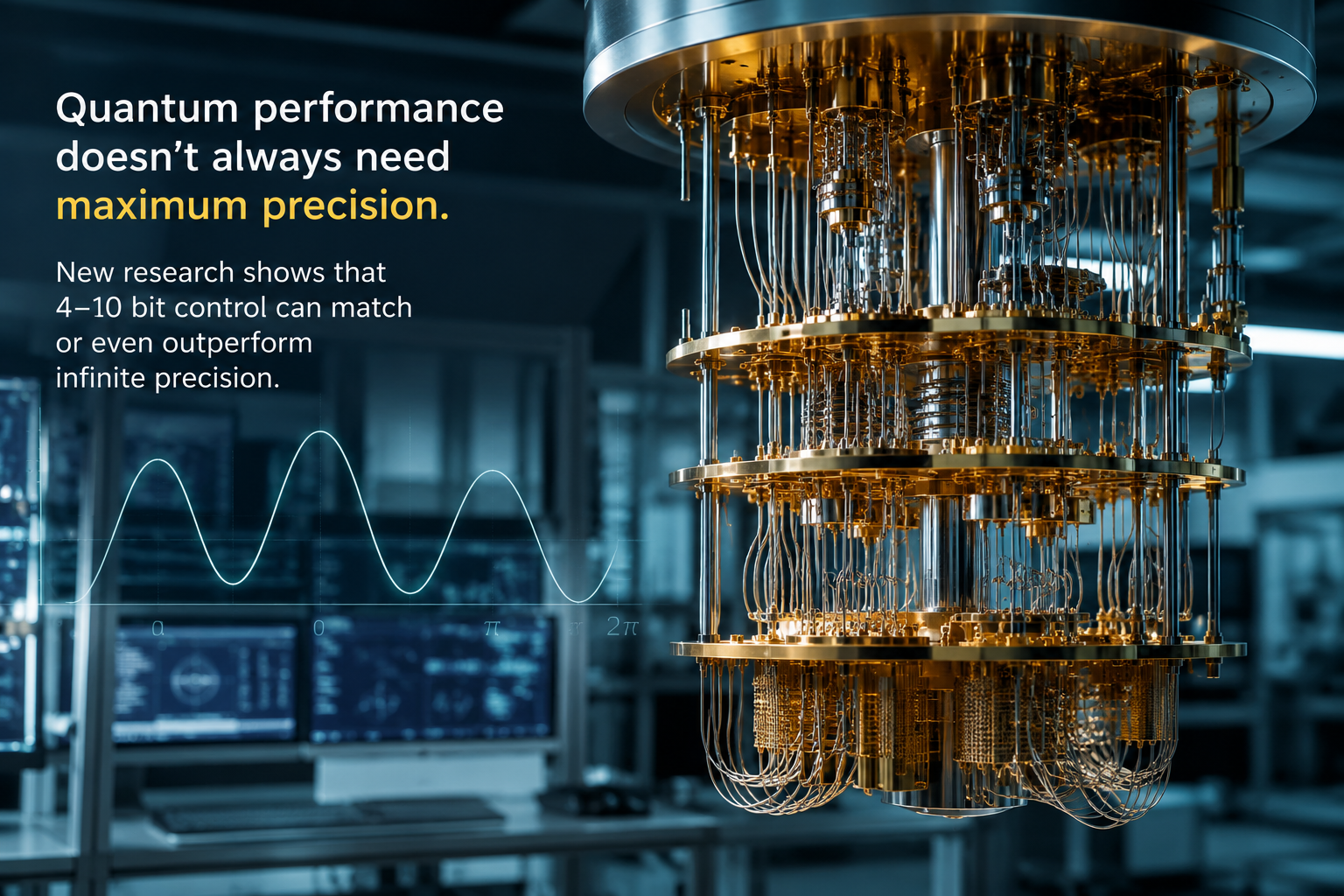
Quantum computers rely on extremely precise electronic control systems to manipulate fragile quantum states. Conventional wisdom suggests that increasing hardware precision always leads to better performance. However, a new study challenges this assumption by demonstrating that quantum neural networks can achieve nearly identical—and in some cases even better—performance using significantly lower-resolution control electronics. The findings could reshape how future quantum computers are designed, making them more energy-efficient, scalable, and practical for real-world quantum machine learning applications.
Key Ideas
Quantum computers depend on Digital-to-Analog Converters (DACs) to generate the analog control signals required for quantum gate operations.
Lower DAC precision dramatically reduces power consumption and hardware complexity, but was traditionally expected to reduce computational performance.
The study shows that pre-trained Quantum Neural Networks maintain almost full accuracy with only 6-bit DACs, while a new stochastic quantization method enables successful training at resolutions between 4 and 10 bits.
Research Context
Scaling quantum computers requires more than improving qubits alone. Modern quantum processors depend on cryogenic control electronics that operate under strict power and thermal constraints. Previous research has largely focused on improving quantum hardware, reducing quantum circuit complexity, or optimizing quantum algorithms. This study instead investigates how the resolution of the control electronics directly affects Quantum Machine Learning performance.
By evaluating multiple Quantum Neural Network architectures across diverse datasets, the authors demonstrate that intelligent hardware-software co-design can overcome limitations previously considered fundamental.
Researchers tested two Quantum Neural Network architectures on four benchmark datasets, including handwritten digit recognition, clothing classification, flower classification, and breast cancer diagnosis. DAC resolutions ranged from 2 to 12 bits.
Results show that:
Pre-trained models maintain near-identical accuracy at 6-bit resolution
4–5 bit systems still preserve over 90% performance
Very low precision introduces a training issue called Gradient Deadlock, where updates become too small to register in hardware
To solve this, the authors introduce Temperature-Controlled Stochastic Quantization, enabling probabilistic updates that bypass hardware discretization limits and sometimes even improve performance.
Why It Matters
This result challenges the assumption that quantum hardware must always maximize precision. Instead, it suggests that reducing control electronics resolution can significantly improve scalability.
Lower-resolution DACs:
Reduce power consumption in cryogenic environments
Decrease chip complexity and manufacturing cost
Reduce thermal load near sensitive quantum hardware
Even more interestingly, stochastic quantization introduces a form of controlled noise that can improve optimization, showing that hardware constraints may sometimes benefit Quantum Machine Learning rather than limit it.
Open Questions
Despite promising results, several questions remain open:
Do these results hold on real quantum hardware beyond simulations?
How do larger Quantum Neural Networks behave under low-resolution control?
Can stochastic quantization be automatically optimized for different architectures?
How does reduced precision interact with quantum noise, decoherence, and error correction?