
Can Silicon Unlock the Future of Million-Qubit Quantum Computers?
The dream of building a practical quantum computer with millions of qubits is one of the greatest technological challenges of the 21st century. While researchers have made remarkable progress in creating increasingly powerful quantum processors, the biggest obstacle is no longer simply producing better individual qubits. The real challenge is architectural: how can we connect, control, and protect millions of fragile quantum systems without creating an engineering nightmare?
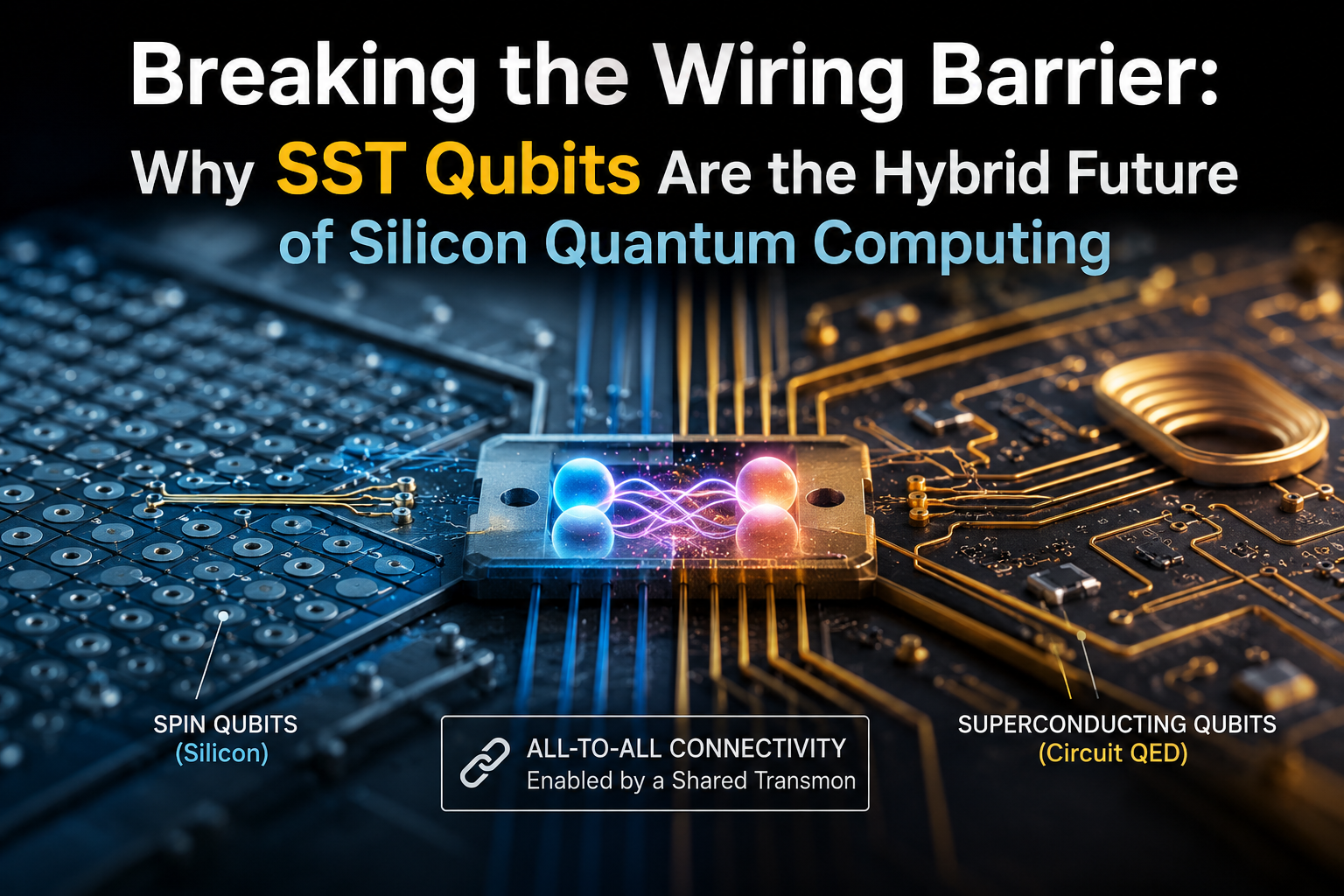
A new approach called the Superconducting Singlet-Triplet Qubit (SST Qubit) proposes a possible solution by combining two of the most promising quantum computing technologies: silicon-based spin qubits and superconducting quantum circuits. Instead of choosing between the scalability of semiconductor technology and the control advantages of superconducting systems, SST attempts to merge both approaches into a single hybrid architecture.
This idea addresses some of the most important limitations facing modern quantum computers, including limited qubit connectivity, excessive wiring requirements, quantum noise, and the difficulty of scaling control systems to extremely large processors.
Although SST qubits are still in the research stage, they represent a broader shift in quantum hardware development: the future of quantum computing may depend not on one perfect qubit technology, but on combining multiple technologies into smarter and more scalable architectures.
Key Takeaways
* The Superconducting Singlet-Triplet Qubit (SST Qubit) is a hybrid quantum computing architecture that combines silicon spin qubits with superconducting circuit technology.
* SST aims to solve some of the biggest challenges in quantum scaling, including qubit connectivity, wiring complexity, and quantum noise.
* The architecture uses silicon-compatible quantum dots combined with superconducting components, allowing researchers to benefit from decades of semiconductor manufacturing experience.
* A shared transmon-based communication system enables all-to-all connectivity, allowing qubits to interact more efficiently compared with architectures limited by nearest-neighbor connections.
* The use of isotopically purified silicon could improve quantum coherence by reducing unwanted interactions between electron spins and atomic nuclei.
* SST does not replace existing quantum computing platforms but introduces a new hybrid direction that could complement superconducting and semiconductor-based approaches.
The Context
Quantum computers operate using quantum bits, or qubits, which can represent information using quantum mechanical states such as superposition and entanglement. Unlike classical bits, qubits can encode and process information in ways that allow quantum computers to solve certain problems much more efficiently than classical machines.
However, building a useful quantum computer is extremely difficult because quantum states are highly sensitive to their environment. Small disturbances from temperature fluctuations, electromagnetic fields, material defects, or atomic interactions can introduce errors and destroy quantum information.
To overcome this challenge, researchers believe that future fault-tolerant quantum computers may require millions of physical qubits. These physical qubits will be needed to create error-corrected logical qubits capable of running practical algorithms.
The challenge is that increasing the number of qubits is not simply a matter of placing more qubits on a chip. A scalable quantum computer requires:
* High-quality qubits with long coherence times.
* Reliable quantum gates with very low error rates.
* Efficient communication between qubits.
* Scalable control and measurement systems.
* Manufacturing methods capable of producing large numbers of identical devices.
Different quantum computing platforms have attempted to solve these problems in different ways.
Superconducting qubits are one of the leading approaches today. These systems use electrical circuits made from superconducting materials and operate at temperatures close to absolute zero. They provide fast operations, strong control techniques, and compatibility with advanced microwave engineering.
However, superconducting systems face a major scaling challenge. Every additional qubit requires more control signals, measurement lines, and cryogenic infrastructure. As processors grow larger, managing thousands or millions of connections becomes increasingly difficult.
Spin qubits provide another promising route. Instead of storing information in large electrical circuits, spin qubits use the quantum spin of individual electrons confined inside semiconductor structures called quantum dots.
Their main advantage is size and compatibility with existing semiconductor technology. In principle, millions of silicon-based spin qubits could fit on a single chip using manufacturing methods similar to those used in conventional electronics.
However, controlling and connecting large numbers of spin qubits remains a major challenge.
The SST architecture attempts to bridge these two worlds by combining the scalability advantages of silicon spin qubits with the mature control techniques of superconducting circuits.
The Main Idea
The Superconducting Singlet-Triplet Qubit (SST Qubit) is based on a hybrid architecture that combines semiconductor quantum dots with superconducting elements.
At the center of the design are parallel double quantum dots connected through a superconducting Josephson junction.
Quantum dots are nanoscale semiconductor structures capable of trapping individual electrons. By controlling these electrons, researchers can manipulate quantum states based on electron spin.
The superconducting component introduces advantages from superconducting quantum circuits, particularly advanced control methods and strong coupling mechanisms.
The result is a qubit architecture that attempts to combine:
* The small size and semiconductor compatibility of spin qubits.
* The controllability and connectivity advantages of superconducting qubits.
One important difference between SST and some previous hybrid quantum designs is that SST does not rely on strong spin-orbit interaction.
Spin-orbit interaction describes the coupling between an electron's spin and its orbital motion. Some hybrid qubit designs require materials with strong spin-orbit properties, such as indium arsenide or germanium.
While these materials can be useful, they are less compatible with the massive industrial infrastructure built around silicon.
Instead, SST uses magnetic field gradients to control electron spin states. This makes the architecture more compatible with silicon-based fabrication.
Silicon is particularly attractive because it can be isotopically purified. Normal silicon contains small amounts of isotopes with nuclear spins that can interact with electron spins and introduce unwanted noise.
By reducing these nuclear interactions, isotopically purified silicon can significantly improve quantum coherence and create a cleaner environment for quantum information processing.
Qubit Connectivity and the All-to-All Advantage
One of the biggest challenges in quantum computing is communication between qubits.
Many current quantum processors rely on architectures where each qubit can only directly interact with nearby qubits. This is similar to a city where every person can only communicate with their immediate neighbors.
When two distant qubits need to exchange information, additional operations such as SWAP gates are required to move quantum states across the processor.
These additional operations create several problems:
* They increase the time needed to execute quantum algorithms.
* They introduce additional sources of error.
* They make quantum error correction more complicated.
The SST architecture introduces a different approach by connecting multiple qubits through a shared transmon.
A transmon is a type of superconducting qubit widely used in modern quantum processors because it provides strong controllability and reliable coupling.
In SST systems, the transmon acts as a quantum communication hub, allowing qubits to interact through a shared connection.
This creates what is known as all-to-all connectivity.
With all-to-all connectivity, any qubit can potentially communicate directly with any other qubit without depending on physical distance.
This could significantly improve:
* Quantum algorithm efficiency.
* Processor architecture design.
* Error correction strategies.
* Scalability of future quantum systems.
Solving the Wiring Bottleneck
Another major challenge for large-scale quantum computers is the control infrastructure.
A quantum processor with millions of qubits cannot simply use millions of individual wires connected to external control electronics.
Quantum processors operate inside dilution refrigerators at temperatures extremely close to absolute zero. Managing a huge number of cables entering and leaving this environment creates enormous engineering difficulties.
The wiring problem affects:
* Physical space inside cryogenic systems.
* Heat management.
* Manufacturing complexity.
* Control electronics scalability.
SST attempts to reduce this problem by simplifying the control architecture.
Instead of requiring a separate complex control system for every operation, the architecture uses magnetic flux control lines to manipulate qubit states.
Reducing the number of high-frequency control connections could become essential for future processors containing thousands or millions of qubits.
The Quantum Physics Behind SST
The unique properties of SST come from a quantum process known as the crossed Andreev process.
In superconducting materials, electrons form pairs called Cooper pairs. These paired electrons have opposite spins and behave collectively as a quantum state.
In the SST architecture, electrons from a Cooper pair can be separated into two different quantum dots while maintaining quantum correlation.
This creates an entangled state sometimes described as an Andreev molecule.
The ability to maintain this connection between separated electrons is what allows SST to store and manipulate quantum information.
By controlling magnetic flux, researchers can tune the quantum state and perform operations needed for quantum computation.
This approach combines superconducting quantum physics with semiconductor spin control, creating a unique hybrid system.
Why It Matters
The importance of SST extends beyond a single qubit design. It represents a new philosophy for building scalable quantum computers.
Instead of searching for one technology that solves every problem, researchers are increasingly exploring hybrid architectures that combine the strengths of multiple platforms.
If successful, SST could provide several important advantages:
Silicon Manufacturing Compatibility
The semiconductor industry has decades of experience producing highly precise silicon devices. A silicon-compatible quantum architecture could potentially benefit from existing manufacturing knowledge and infrastructure.
Improved Connectivity
Efficient qubit communication is essential for complex quantum algorithms and quantum error correction. All-to-all connectivity could reduce unnecessary operations and improve performance.
Reduced Engineering Complexity
Large-scale quantum computers require practical solutions for control, cooling, and wiring. Architectures that simplify these requirements will be critical for future commercialization.
A Path Toward Fault-Tolerant Quantum Computing
The ultimate goal of quantum hardware research is not simply creating more qubits, but creating reliable quantum computers capable of solving real-world problems.
SST represents one possible pathway toward this goal.
Limitations and Open Challenges
Despite its potential, SST technology remains at an early research stage and faces several important challenges.
Fabrication Complexity
Unlike simpler qubit designs, SST requires multiple quantum components, including quantum dots and superconducting structures. Manufacturing these systems with high precision remains challenging.
Quantum Readout
Accurately measuring individual qubits while maintaining scalability is one of the hardest problems in quantum hardware.
Future SST systems will require improved readout techniques capable of handling large numbers of qubits efficiently.
Demonstrating Large-Scale Performance
A promising architecture must eventually demonstrate:
* Long coherence times.
* High-fidelity quantum gates.
* Reliable operation across many qubits.
* Compatibility with quantum error correction.
Only large-scale experimental demonstrations will determine whether SST can compete with other leading quantum technologies.
What To Watch Next
Future research on SST qubits will likely focus on several key areas:
* Improving fabrication methods for silicon-superconductor hybrid devices.
* Increasing qubit coherence and reducing environmental noise.
* Developing scalable readout systems.
* Building larger arrays of interconnected SST qubits.
* Testing compatibility with fault-tolerant quantum error correction.
The next few years will reveal whether SST remains an interesting laboratory concept or becomes part of the foundation for future quantum computers.
The challenge of building a million-qubit quantum computer remains enormous, but solving problems like connectivity, control, and scalability is exactly where new architectures such as SST could make a significant impact.


