Can Quantum Computing Finally Solve One of Plasma Physics' Greatest Challenges?
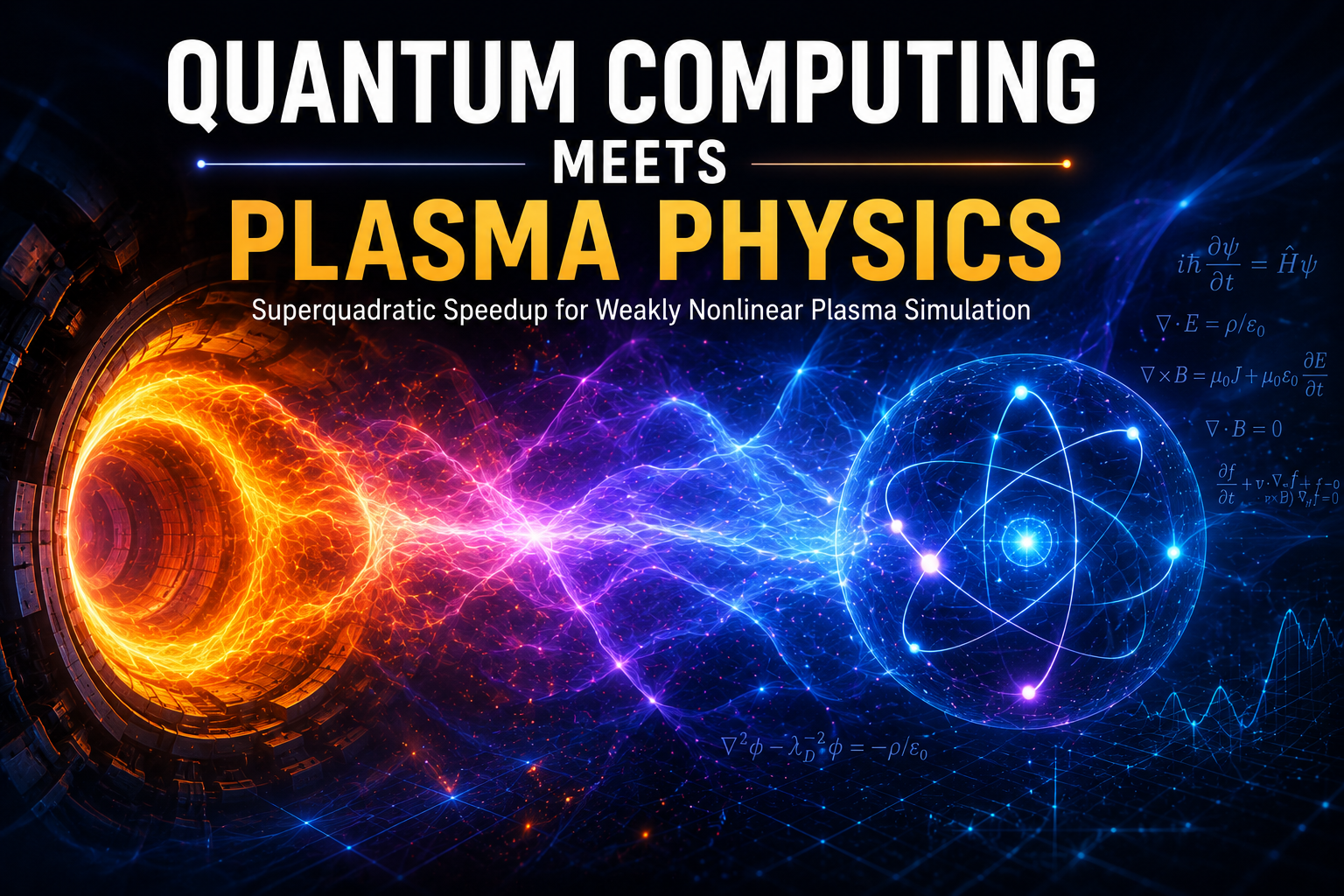
Plasma is often referred to as the fourth state of matter and makes up more than 99% of the visible universe. It exists inside the Sun, stars, lightning, and experimental nuclear fusion reactors. Understanding how plasma behaves is essential for developing clean fusion energy, predicting space weather, and advancing astrophysics. However, plasma is also one of the most computationally challenging systems to simulate because billions of charged particles continuously interact with each other through electromagnetic fields. Even today's most powerful supercomputers struggle to model these interactions efficiently as the system grows larger. A newly proposed quantum algorithm introduces a different approach that could eventually allow quantum computers to simulate plasma far more efficiently than classical computing methods, representing an important step toward practical quantum simulation for scientific research.
Key Takeaways
* Researchers developed one of the first complete end-to-end quantum algorithms specifically designed for simulating weakly nonlinear plasma systems.
* The algorithm combines advanced mathematical techniques, including Carleman Embedding and Hierarchical Block Encoding, to transform highly complex nonlinear plasma equations into forms suitable for quantum computation.
* The study demonstrates a superquadratic speedup over existing classical approaches while requiring only a logarithmic increase in the number of qubits as the problem size grows.
* Although the method currently targets weakly nonlinear plasma, it establishes a scalable framework that could support future research in plasma physics, fusion energy, astrophysics, and quantum simulation.
The Context
Plasma physics has become increasingly important because of its direct connection to some of the world's biggest scientific and engineering challenges. Controlled nuclear fusion promises a nearly limitless source of clean energy, while plasma also plays a central role in solar physics, space weather forecasting, particle accelerators, and many industrial technologies.
Accurately simulating plasma requires solving extremely large systems of nonlinear differential equations that describe the motion of charged particles and their interactions with electromagnetic fields. As these systems become larger, the computational cost increases dramatically, making high-precision simulations prohibitively expensive even for modern supercomputers.
Quantum computing has emerged as a promising alternative for scientific simulation because quantum systems naturally represent many of the physical processes found in nature. For years, researchers have investigated whether quantum computers could efficiently solve plasma simulations, but constructing a complete end-to-end quantum algorithm remained an open challenge.
The Main Idea
The new study introduces a comprehensive quantum algorithm capable of simulating weakly nonlinear plasma from beginning to end.
The first challenge addressed by the researchers is the nonlinear nature of plasma equations. Quantum computers naturally solve linear systems, while plasma dynamics are fundamentally nonlinear because charged particles continuously influence both the electric fields and each other. To overcome this limitation, the algorithm applies Carleman Embedding, a mathematical technique that transforms nonlinear equations into a larger linear system while maintaining controlled approximation accuracy.
Once transformed, the algorithm uses Hierarchical Block Encoding to efficiently represent the resulting mathematical operators inside a quantum computer. This significantly reduces the resources needed to manipulate extremely large datasets that would otherwise become computationally impractical.
Finally, instead of reconstructing the complete quantum state, the algorithm directly estimates physically meaningful quantities, such as the plasma's average kinetic energy. This measurement strategy avoids unnecessary computational overhead while preserving the scientific information researchers actually need.
Together, these components create one of the first fully integrated quantum frameworks for realistic plasma simulation rather than solving only isolated portions of the overall computational problem.
Why It Matters
Quantum simulation is widely regarded as one of the most valuable long-term applications of quantum computing, and plasma physics represents one of its most demanding targets.
If scalable quantum hardware becomes available, algorithms like this could dramatically reduce the computational cost of studying plasma behavior inside fusion reactors, helping scientists optimize reactor designs and accelerate the development of practical fusion energy.
Beyond energy research, improved plasma simulations could contribute to better models of stellar evolution, solar activity, space weather prediction, high-energy astrophysics, and laboratory plasma experiments. The work also demonstrates how advanced quantum algorithms can address nonlinear scientific problems that have traditionally been considered beyond the reach of efficient computation.
More broadly, this research strengthens the growing role of quantum computing as a scientific tool rather than simply a faster computer, highlighting its potential to solve classes of problems that are fundamentally difficult for classical machines.
What To Watch Next
Although the results are highly encouraging, several important challenges remain.
The current algorithm is limited to weakly nonlinear plasma systems, meaning it cannot yet simulate highly turbulent plasma environments commonly found in fusion devices or astrophysical systems. Extending these techniques to strongly nonlinear plasma remains an important area for future research.
Another limitation is today's quantum hardware. Existing quantum processors do not yet provide enough high-quality qubits or sufficiently low error rates to execute algorithms of this scale. Future fault-tolerant quantum computers will likely be required before these theoretical advantages can be fully demonstrated experimentally.
Future research will focus on expanding the algorithm to more realistic plasma models, reducing quantum resource requirements even further, and validating these methods on next-generation quantum hardware.