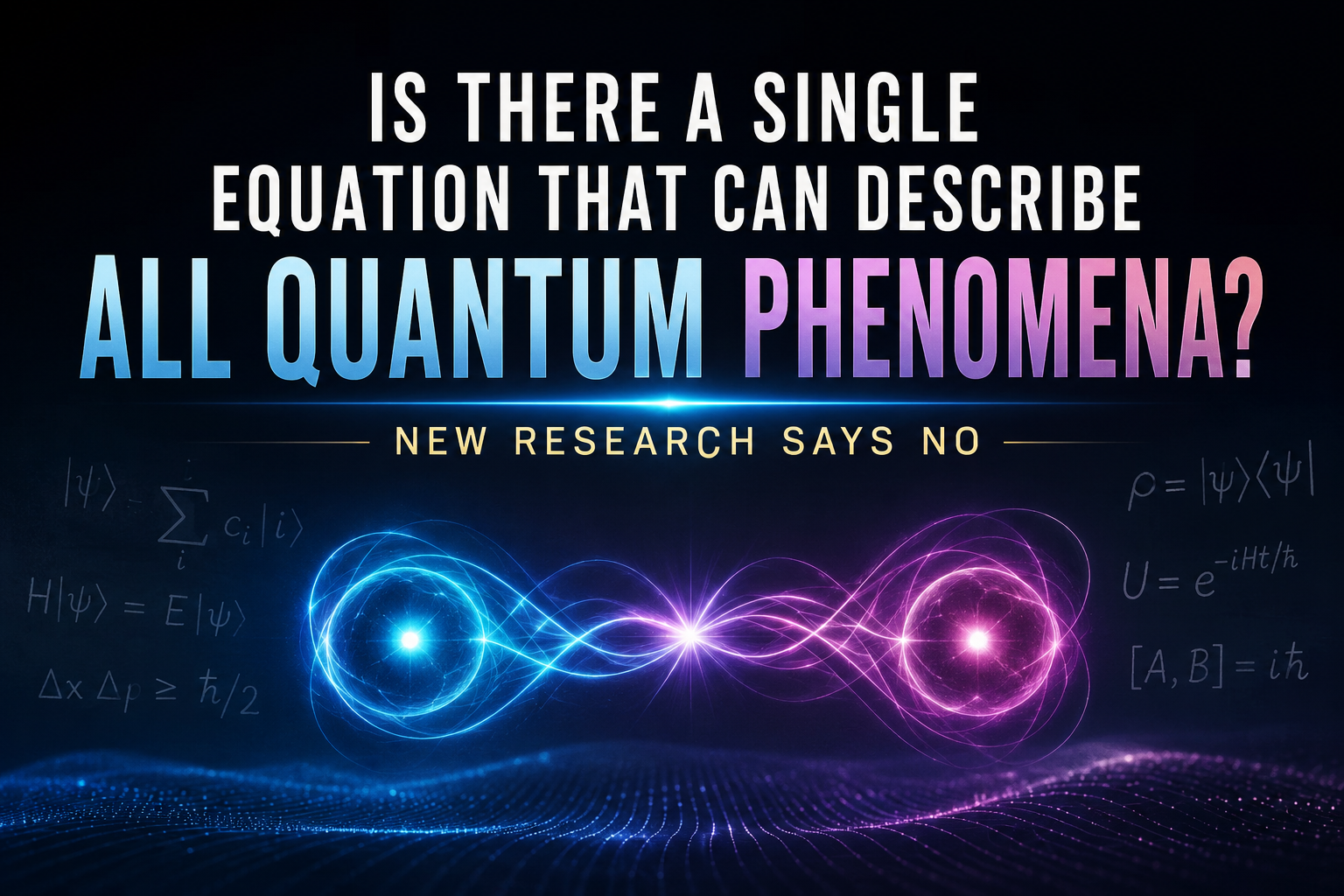
Can One Mathematical Model Describe All Quantum Phenomena?
Quantum mechanics has transformed our understanding of nature, enabling technologies such as quantum computing, quantum communication, and quantum cryptography. Yet one of its deepest mathematical questions has remained unanswered for decades: How can we determine whether a set of observed correlations truly belongs to quantum mechanics? Although physicists have developed powerful mathematical tools to approximate the set of all possible quantum correlations, it has never been clear whether one finite mathematical model could completely describe them. A new study now settles this long-standing question. The researchers prove that no finite level of the NPA Hierarchy can exactly characterize the complete Quantum Set, revealing a fundamental limitation in one of quantum information science's most important mathematical frameworks.
Key Takeaways
* Researchers proved that no finite level of the NPA Hierarchy can fully characterize the complete Quantum Set.
* The proof resolves a long-standing open problem in quantum information theory using rigorous mathematical analysis.
* The result establishes a fundamental mathematical limitation while reinforcing the NPA Hierarchy as one of the most powerful approximation tools for studying quantum correlations.
The Context
One of the central goals of quantum information science is to determine whether the correlations observed in experiments can genuinely arise from quantum mechanics. This question is essential for Bell tests, quantum nonlocality, device-independent quantum cryptography, and the certification of quantum computers.
To study these correlations, researchers use the NPA Hierarchy, a mathematical framework introduced by Miguel Navascués, Stefano Pironio, and Antonio Acín. Rather than describing the Quantum Set directly, the hierarchy produces a sequence of increasingly accurate approximations. Every new level adds additional mathematical constraints, bringing the approximation closer to the true set of quantum correlations allowed by nature.
Because the approximations become remarkably accurate at higher levels, researchers have long wondered whether a sufficiently high finite level could eventually become exact. If such a level existed, it would provide a complete mathematical characterization of quantum correlations while remaining computationally manageable.
For more than fifteen years, this question remained one of the major open problems in quantum information theory.
The Main Idea
The new study proves that the answer is no.
The researchers demonstrate that every finite level of the NPA Hierarchy remains only an approximation of the complete Quantum Set. Regardless of how many levels are added, there will always exist physically valid quantum correlations that cannot be captured exactly by that finite description.
Remarkably, this limitation already appears in the simplest Bell scenario involving binary measurements. This means the limitation is not caused by complicated quantum systems or high-dimensional quantum states. Instead, it reflects a fundamental property of the mathematical structure of quantum mechanics itself.
The proof focuses on the Doubly Tilted CHSH inequality, a generalized version of one of the most famous Bell inequalities used to study quantum nonlocality. Through a rigorous analytical derivation, the authors characterize the behavior of the quantum boundary near a critical endpoint and show that no finite level of the hierarchy can reproduce it exactly.
An essential ingredient of the proof is the Motzkin Polynomial, a famous mathematical object from algebra. Although the polynomial is always non-negative, it cannot be represented as a finite sum of squares. By connecting this property to the optimization framework underlying the NPA Hierarchy, the researchers demonstrate why every finite hierarchy level inevitably fails to describe the complete Quantum Set.
Unlike previous investigations that relied primarily on numerical evidence, this work provides a complete mathematical proof, resolving the problem definitively.
Why It Matters
This result has broad implications for both theoretical physics and practical quantum technologies.
The NPA Hierarchy is widely used to verify Bell experiments, certify quantum devices, analyze quantum communication protocols, study quantum nonlocality, and develop device-independent quantum cryptography. It has become one of the standard mathematical tools used throughout quantum information science.
The new proof does not reduce the importance of the hierarchy. Instead, it clarifies exactly what the hierarchy can and cannot achieve. Every finite level provides an increasingly accurate approximation of quantum reality, but no finite level can completely characterize it.
This insight will influence future research on quantum certification, optimization algorithms, and mathematical models for quantum systems. It also strengthens our understanding of the geometric structure of the Quantum Set and demonstrates that quantum mechanics possesses mathematical complexity that cannot be captured by any finite collection of polynomial constraints.
More broadly, the work highlights the deep relationship between quantum physics, convex optimization, algebra, and computational mathematics, illustrating how advances in pure mathematics continue to shape the future of quantum technologies.
What To Watch Next
This breakthrough resolves one important question while opening several new directions for future research.
Scientists will now investigate whether alternative mathematical hierarchies can characterize quantum correlations more efficiently, whether stronger optimization techniques can produce tighter approximations with lower computational cost, and whether similar limitations exist in other mathematical frameworks used throughout quantum information science.
Researchers are also expected to explore new connections between semidefinite programming, algebraic geometry, polynomial optimization, and quantum foundations. These developments could eventually improve the verification of large-scale quantum computers, strengthen quantum communication protocols, and enable more reliable certification methods for future quantum technologies.
As quantum hardware continues to advance, understanding both the capabilities and the mathematical limits of our verification tools will become increasingly important.