
I've prepared a version that follows your template exactly, uses `##` headings, keeps the flow engaging and readable, and is detailed enough for your Quantum Articles website without becoming overly technical.
The Quantum Marriage: How Giant Atoms Are Revolutionizing Hybrid Quantum Computing
Quantum computing has reached an important turning point. Over the past two decades, researchers have developed several promising hardware platforms, each offering unique advantages but also facing significant limitations. Neutral atoms can be arranged into massive arrays using optical tweezers, making them one of the most scalable quantum technologies available today. Trapped ions, by contrast, have become the benchmark for high-fidelity quantum operations and long coherence times, but they become increasingly difficult to scale as the number of ions grows. For years, this trade-off has forced scientists to choose between scalability and precision.
A new theoretical proposal from the Weizmann Institute of Science suggests that this compromise may no longer be necessary. Instead of relying on a single quantum technology, the researchers propose combining two of the field's strongest platforms into one hybrid quantum architecture. By using giant Rydberg atoms as a quantum interface between neutral atoms and trapped ions, the study presents a practical strategy for building quantum computers that are both scalable and highly accurate. If experimentally realized, this approach could reshape how future quantum processors are designed.
Key Takeaways
* Researchers propose a hybrid quantum architecture that combines neutral atoms and trapped ions within a single quantum processor.
* Giant Rydberg atoms provide the long-range interaction needed to connect two quantum systems that normally cannot communicate efficiently.
* The proposed architecture combines the scalability of neutral atoms with the exceptional gate fidelity of trapped ions.
* The work introduces a deterministic hybrid quantum gate and identifies practical conditions for stable experimental implementation.
* Hybrid quantum architectures could become a key building block for future fault-tolerant quantum computers and distributed quantum networks.
The Context
Quantum computing hardware is currently developing along several independent technological paths. Among the most successful are neutral atom systems and trapped-ion processors.
Neutral atoms are trapped and manipulated using highly focused laser beams known as optical tweezers. Because thousands of atoms can be positioned into programmable arrays, this platform has become one of the leading candidates for building large-scale quantum processors. However, maintaining consistently high gate fidelities across large systems remains a major engineering challenge.
Trapped-ion systems follow a different approach. Individual ions are confined using oscillating electromagnetic fields inside Paul traps. These systems routinely achieve some of the highest gate fidelities and longest coherence times ever demonstrated in quantum computing. Their primary limitation is scalability. As additional ions are loaded into the trap, the number of collective vibrational modes grows rapidly, making quantum control increasingly complex. This phenomenon, known as mode crowding, eventually limits the practical size of ion-based processors.
For many years, these platforms have been viewed as competing technologies. Researchers typically focused on improving one approach while accepting its inherent limitations. The new study proposes a different philosophy: rather than choosing between them, combine both systems into a single hybrid architecture that allows each platform to contribute its greatest strengths.
The Main Idea
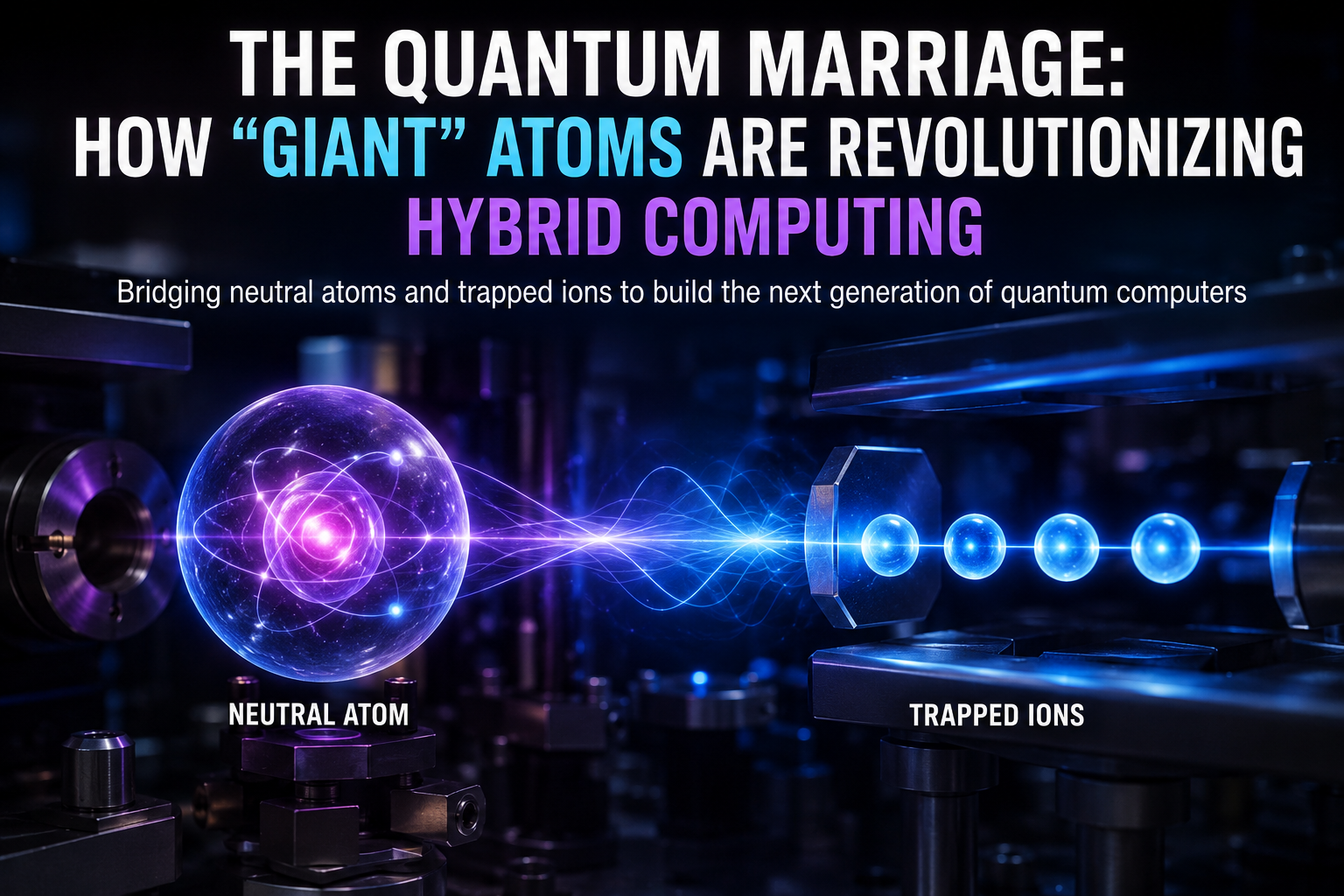
The central innovation of the study is the use of Rydberg atoms as a quantum bridge between neutral atoms and trapped ions.
A Rydberg atom is created by exciting one of an atom's electrons to an extremely high energy level. The excited electron moves far away from the nucleus, making the atom dramatically larger than its normal size. Because of this enormous electronic orbit, Rydberg atoms are often referred to as "giant atoms."
More importantly, entering a Rydberg state dramatically increases the atom's polarizability—its ability to respond to external electric fields. According to the theoretical model, the static polarizability scales approximately with the seventh power of the principal quantum number (n⁷). This means that even relatively small increases in excitation produce enormous increases in sensitivity to nearby electric fields.
This property completely changes how a neutral atom behaves. Instead of interacting only weakly with electric fields, the Rydberg atom develops a strong long-range polarization interaction with nearby trapped ions. Although the atom remains electrically neutral, it effectively becomes a highly sensitive mediator capable of coupling two fundamentally different quantum systems.
The interaction is sufficiently strong to modify the collective vibrational motion of an ion crystal. Inside a Paul trap, ions oscillate together through collective normal modes that are essential for implementing quantum gates. By exciting a nearby neutral atom into a Rydberg state, researchers can shift the frequency of these collective vibrations, particularly the Center-of-Mass mode. In effect, a single neutral atom acts like a remote control that adjusts the motion of an entire ion crystal without any physical contact.
Building on this mechanism, the researchers designed a deterministic hybrid quantum gate. In their proposal, the neutral atom functions as the control qubit, while two trapped ions serve as target qubits. When the atom remains in its stable clock state, its influence on the ions is negligible, allowing the ions to perform their entangling operation normally. However, when the atom is excited to a Rydberg state, its enhanced interaction changes the ions' vibrational frequency, altering the geometric phase accumulated during the gate operation. Under carefully chosen operating conditions, this suppresses the formation of entanglement between the ions. The internal state of a single neutral atom therefore determines whether an ion-based quantum gate succeeds, creating one of the first practical proposals for a deterministic hybrid quantum gate.
The study also reports a surprising physical result. Conventional intuition suggests that charged ions should always experience stronger confinement than neutral atoms inside an ion trap. However, the researchers demonstrate that highly excited Rydberg atoms can actually become more tightly confined than the ions themselves. This occurs because Rydberg atoms interact with the oscillating electric field through the quadratic Stark effect, and their enormous polarizability generates an exceptionally strong restoring force toward the trap center. This counterintuitive behavior highlights the unusual physics that emerges in giant atomic states.
To ensure stable operation, the researchers identified specific strontium Rydberg states with negative polarizability that naturally remain confined near the radio-frequency null of the Paul trap. They also identified a magic wavelength near 596 nm, where both the clock state and the Rydberg state experience identical optical trapping conditions. This minimizes unwanted light shifts, preserves quantum coherence, and improves the stability of quantum gate operations.
Why It Matters
This research represents more than a new quantum gate proposal. It introduces a new philosophy for designing future quantum computers.
Instead of searching for one hardware platform capable of solving every engineering challenge, future quantum processors may combine multiple specialized technologies into a unified architecture. Neutral atoms can provide the scalability required for processors containing thousands or even millions of qubits. Trapped ions can deliver the precision necessary for fault-tolerant quantum computation. Rydberg atoms can serve as the quantum interface that allows these independent systems to communicate efficiently.
Beyond quantum computing, hybrid atom-ion interfaces could enable new approaches in quantum simulation, quantum networking, distributed quantum computing, and the future quantum internet. They may also provide powerful experimental platforms for studying many-body quantum physics with unprecedented levels of control.
What To Watch Next
* Experimental demonstration of deterministic hybrid quantum gates between neutral atoms and trapped ions.
* Scaling hybrid architectures beyond proof-of-concept experiments while maintaining high gate fidelity.
* Improving coherence times and suppressing decoherence in large hybrid quantum processors.
* Exploring additional atomic species and Rydberg states that could improve performance.
* Integrating hybrid atom-ion systems into future distributed quantum computing and quantum internet architectures.


