
How Can We Measure Information Loss in Quantum Computers More Accurately?
Quantum computers promise to solve problems that are beyond the reach of classical machines, but they face one fundamental challenge: preserving fragile quantum information. Every quantum operation introduces some level of noise, causing quantum states to gradually lose their original properties. These changes are described by quantum channels, mathematical models that represent how quantum information evolves during computation or communication.
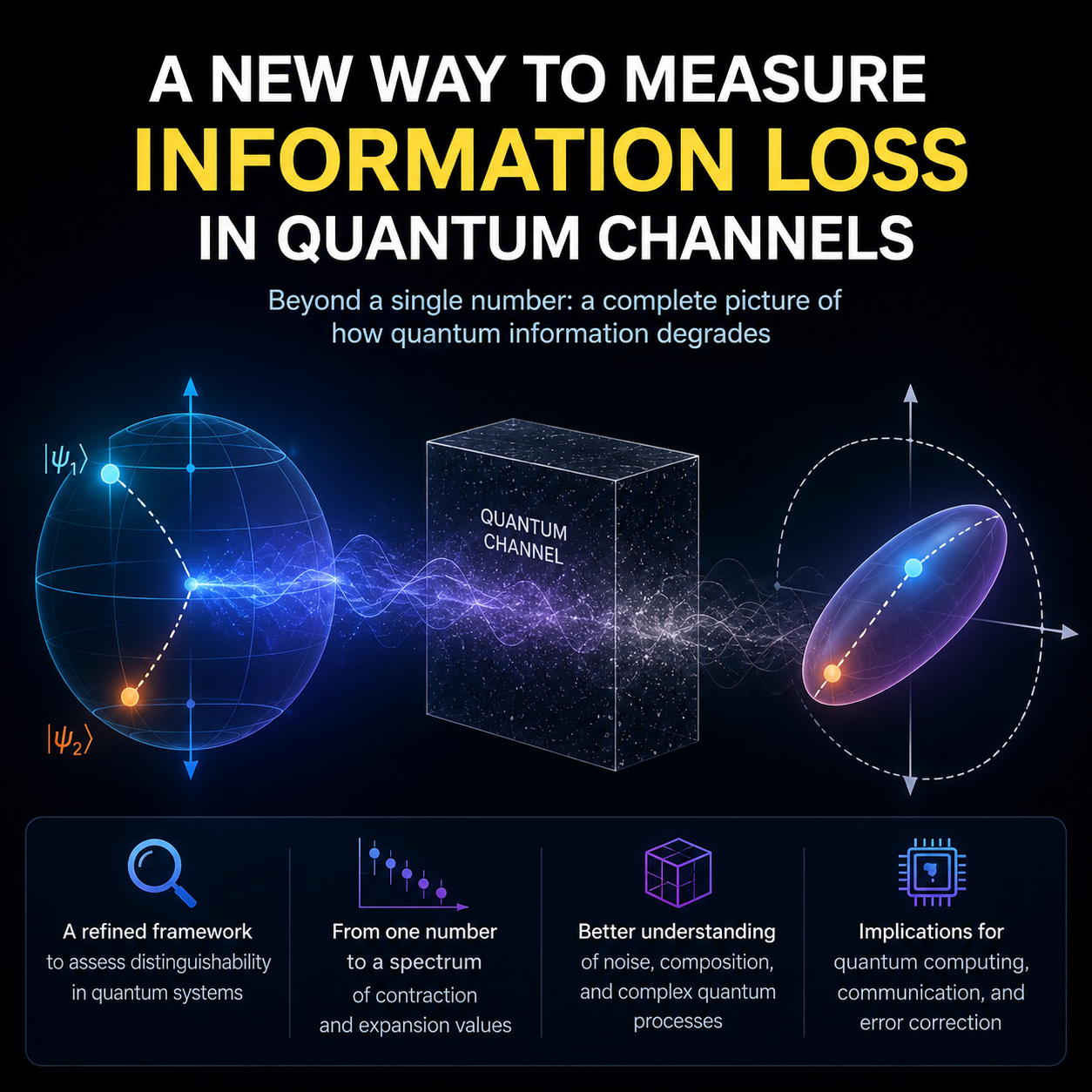
For decades, researchers have relied on a single quantity called the contraction coefficient to measure how much information a quantum channel preserves. While this metric has been extremely useful, it only captures the best-case behavior of a channel. In practice, quantum channels behave differently depending on the quantum states involved, meaning that one number cannot fully describe how information is lost. This research introduces a more comprehensive framework that measures information degradation from multiple perspectives, providing a far more accurate understanding of quantum channels and their behavior.
Key Ideas
- Traditional measurements have limitations. The contraction coefficient measures how well a quantum channel preserves the distinguishability between two quantum states, but it only reflects one extreme case and often overlooks the channel's overall behavior.
- A new framework introduces contraction and expansion values. Instead of relying on a single number, the researchers define two ordered sequences that describe how information changes across different directions within a quantum channel, offering a much richer characterization.
- The approach provides a more complete picture of quantum channels. Like evaluating an entire camera image instead of only its center, the new method captures information loss throughout the whole channel rather than focusing on one favorable scenario.
- The new quantities have a clear physical interpretation. The researchers demonstrate their meaning through a quantum state discrimination game, where preserving distinguishability between quantum states directly reflects how well a channel protects information.
- The framework is especially useful for complex quantum computations. Since real quantum computers apply many quantum operations in sequence, the new method offers a much more accurate way to analyze how information gradually degrades throughout an entire computation.
- The theory was validated on important quantum channels. Tests on single-qubit channels and amplitude damping channels showed that the framework reveals properties that traditional single-number measurements cannot capture.
Research Context
Understanding how noise affects quantum information is one of the central challenges in Quantum Information Theory (QIT). The contraction coefficient has been widely used to study quantum communication, quantum algorithms, open quantum systems, and quantum error mitigation. However, as quantum hardware becomes more advanced, researchers have recognized that a single scalar value is no longer sufficient to describe increasingly complex quantum channels.
This work extends the traditional contraction coefficient into an ordered spectrum of contraction and expansion values. Inspired by ideas similar to singular values in linear algebra, the framework provides a deeper understanding of how quantum information changes under noise while also connecting quantum information theory with well-established mathematical tools from operator analysis.
Why It Matters
A better understanding of information loss is essential for building practical quantum technologies. More accurate measurements of quantum channel performance can improve quantum algorithms, strengthen Quantum Error Correction (QEC), enhance quantum communication systems, and help engineers design more reliable quantum hardware.
By providing a far more detailed description of quantum channels, this framework offers researchers powerful new tools for studying noise and optimizing future quantum computers. As quantum devices continue to scale, these techniques may become increasingly important for making quantum computation more stable, accurate, and practical.
Open Questions
- Can these new quantities be computed efficiently for large quantum systems? Developing practical algorithms remains an important challenge.
- How do contraction and expansion values behave for more complex quantum noise models? Future work will investigate larger multi-qubit systems and realistic hardware.
- Can this framework improve quantum error correction and fault-tolerant computing? Researchers hope these new measurements will help design more robust quantum architectures.
- How can these ideas be applied to emerging fields? Potential applications include quantum communication, quantum machine learning, and next-generation quantum networks.
- Will these mathematical tools become standard benchmarks for quantum hardware? As quantum computers continue to improve, contraction and expansion values may provide a more reliable way to evaluate and compare quantum devices.


