
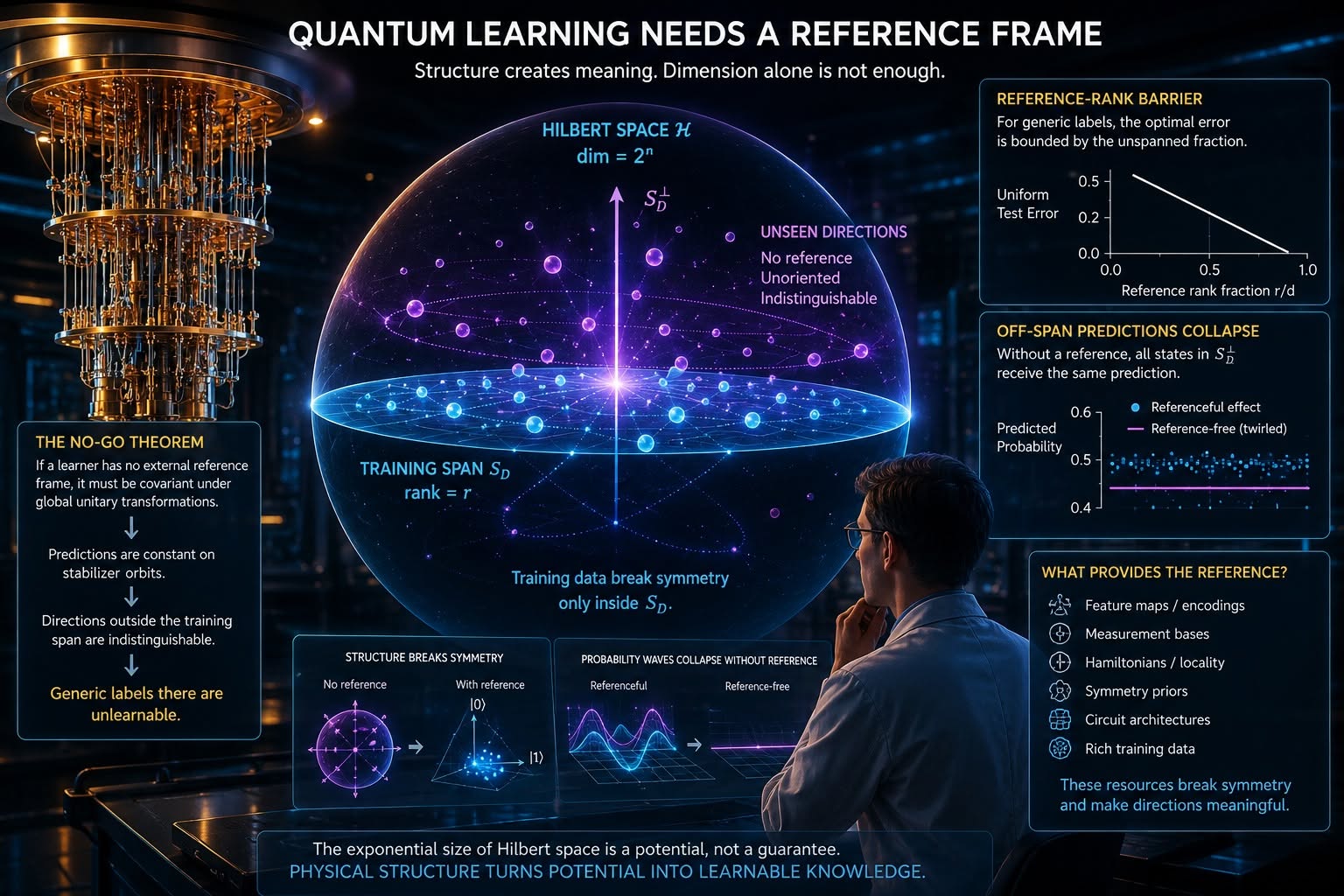
Why Hilbert Space Alone Cannot Power Quantum Machine Learning
Quantum Machine Learning (QML) is frequently introduced with a compelling argument: because an n-qubit quantum computer operates in a Hilbert space containing \(2^n\) dimensions, it can naturally represent an exponentially large feature space. This idea has led many researchers to believe that simply increasing the number of qubits should provide increasingly powerful learning capabilities.
A recent theoretical study challenges this assumption by asking a more fundamental question: Can a learning algorithm actually assign meaning to every direction inside such a vast mathematical space?
The authors prove that the answer is no. Hilbert space alone does not provide enough information for a quantum learning model to generalize beyond its training data. Instead, successful learning requires additional physical structures—such as feature maps, measurement bases, Hamiltonians, symmetry priors, circuit architectures, or sufficiently informative training data—that provide a reference for interpreting unseen quantum states.
Rather than viewing quantum advantage as a direct consequence of exponentially large state spaces, the paper argues that the true source of generalization lies in the physical structures that give those states meaning.
Key Ideas
- Hilbert space is not automatically a learnable feature space simply because it is exponentially large.
- Quantum Machine Learning requires physical reference structures to interpret unseen quantum states.
- The paper proves that a reference-free learner cannot distinguish unseen quantum directions outside the span of its training data.
- Modern QML algorithms succeed because they include feature maps, observables, measurement bases, Hamiltonians, symmetry priors, and circuit architectures that provide the missing reference.
Research Context
Quantum Machine Learning has advanced rapidly through quantum kernels, variational quantum circuits, quantum neural networks, and quantum feature maps. Previous theoretical work has largely focused on optimization challenges such as barren plateaus, quantum no-free-lunch theorems, and model capacity.
This paper studies a different problem entirely: identifiability.
Rather than asking whether a quantum model can optimize successfully, the authors investigate whether the learning problem itself contains enough physical information for unseen quantum states to receive different labels. They formulate supervised learning without any external quantum reference frame and prove that, without additional physical structure, many unseen quantum states become fundamentally indistinguishable from the learner's perspective.
The work reframes quantum generalization as a problem of symmetry breaking, showing that physical reference structures—not Hilbert-space dimension alone—allow learning algorithms to assign meaningful predictions beyond their training examples.
Why It Matters
The study changes how researchers should evaluate claims of quantum advantage in artificial intelligence.
Instead of focusing only on the number of qubits or the size of Hilbert space, researchers should also ask what physical structures enable a model to interpret quantum data and generalize to unseen states.
Importantly, the paper does not argue that Quantum Machine Learning cannot work. Instead, it explains why practical QML systems succeed. Feature maps, measurement bases, Hamiltonians, locality assumptions, symmetry priors, quantum circuit architectures, and sufficiently diverse training datasets all provide the reference information required for meaningful learning.
The work also provides a valuable theoretical framework for designing future quantum AI systems, suggesting that improvements may come not only from larger quantum processors but also from richer physical structures that guide learning.
Open Questions
- Can more efficient quantum reference structures reduce the amount of training data needed for reliable generalization?
- Which physical priors provide the strongest inductive bias for different Quantum Machine Learning tasks?
- How can future QML architectures explicitly incorporate symmetry breaking while remaining computationally efficient?
- Can these ideas improve learning performance on noisy intermediate-scale quantum (NISQ) hardware?
- Should future benchmarks for quantum advantage evaluate not only Hilbert-space size but also the reference structures that enable learning?


