
Comparing Quantum Programming Languages: Why No Single Framework Leads Across Every Category
Intro
As quantum computers continue to advance, many people assume that the main challenge is simply increasing the number of qubits or improving quantum processors. In reality, hardware alone does not determine whether useful quantum applications can be built.
Just as classical computing depended on programming languages and software ecosystems to become practical and scalable, the future of quantum computing will also depend on programming environments that allow researchers to design, test, and deploy quantum algorithms efficiently.
A recent scientific study explored this challenge by comparing leading quantum programming languages and frameworks to evaluate how prepared they are for future quantum applications and large scale quantum development.
Key Ideas
• No single quantum programming language currently outperforms all others.
• Different frameworks prioritize different goals such as expressiveness, simplicity, performance, or software safety.
• Software ecosystems may become as important as hardware advances for future quantum computing progress.
Study Design
Quantum programming differs fundamentally from classical programming. Classical software operates using Bits that represent either zero or one, while quantum software operates using Qubits that can exist in multiple states simultaneously through Superposition and interact through Entanglement.
Programming quantum systems also introduces additional complexity because Quantum Measurement affects system behavior and resource management becomes significantly more constrained.
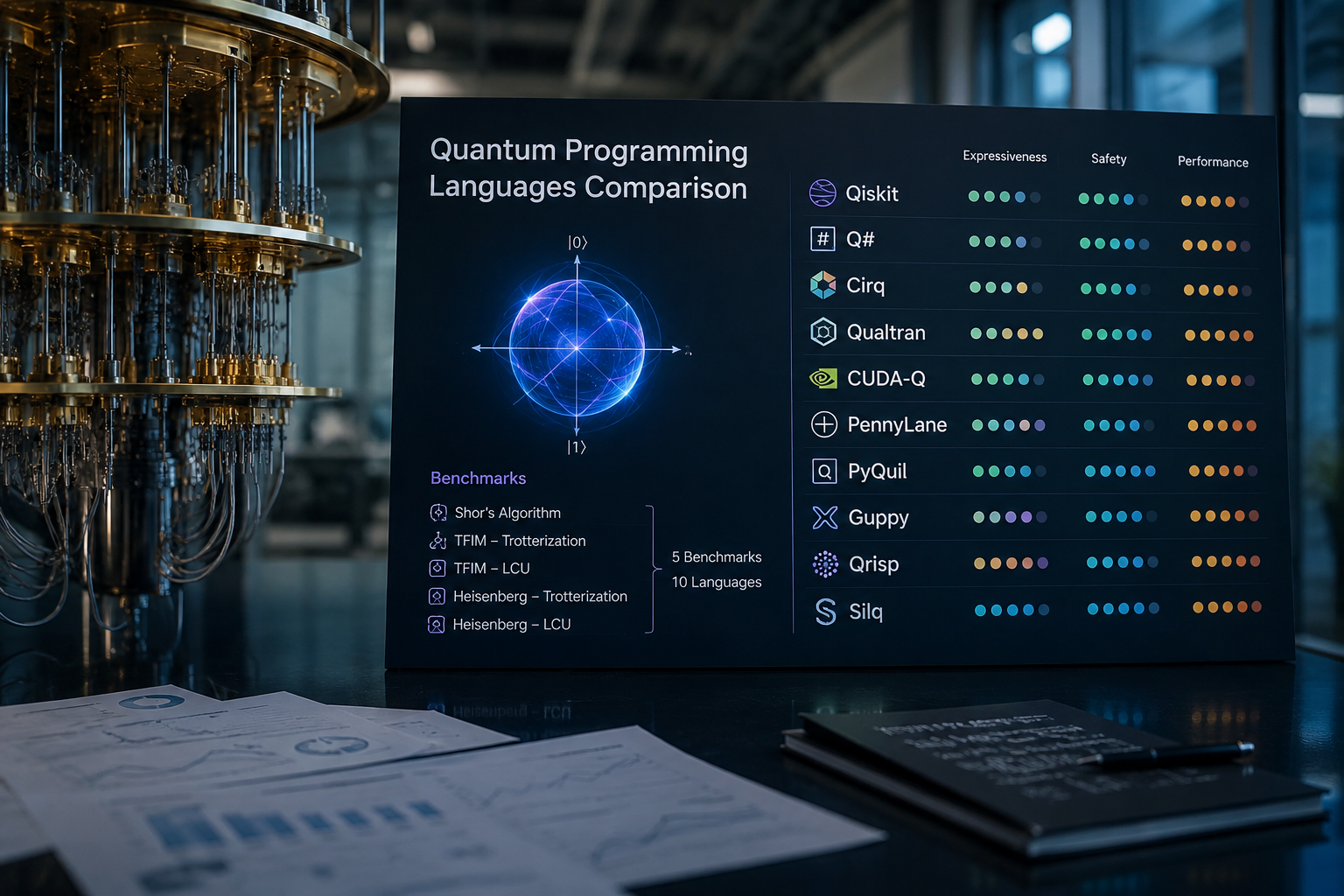
To evaluate the current state of quantum software development, researchers conducted a large comparative study using fifty benchmark implementations built from five benchmark programs across ten quantum languages and frameworks.
The comparison evaluated:
• Lines of code
• Compilation performance
• Execution performance
• Result correctness
• Development usability
The study included the following environments:
1. Qiskit
2. Q#
3. Cirq
4. Qualtran
5. CUDA Q
6. PennyLane
7. PyQuil
8. Guppy
9. Qrisp
10. Silq
The benchmark programs were built around two major application domains.
The first application used Shor's Algorithm, one of the best known quantum algorithms because of its theoretical ability to accelerate integer factorization under future large scale quantum hardware.
The second application focused on Hamiltonian Simulation, an important area of quantum computing research with potential applications in physics, chemistry, material discovery, and computational drug development.
The study also evaluated different physical and simulation approaches including:
• Transverse Field Ising Model (TFIM)
• Heisenberg Model
• Trotterization
• Linear Combination of Unitaries (LCU)
Researchers evaluated all frameworks across three major dimensions:
• Programming Model
• Expressiveness
• Software Safety
Why It Matters
The results showed that every language and framework reflects a different design philosophy.
Some environments prioritize ease of development and accessibility. Others emphasize expressive abstractions that reduce implementation complexity. Some focus on stronger compile time validation and safer management of quantum resources.
The study also showed that higher level abstractions can reduce development effort and improve maintainability, while lower level approaches may offer greater flexibility at the cost of increased implementation complexity.
The broader conclusion is that future progress in quantum computing will not depend only on building better processors. It will also depend on creating software environments capable of making quantum development more practical, reliable, and scalable.
Open Questions
Although no framework emerged as universally superior, several important questions remain open.
Will future hardware architectures favor certain programming paradigms?
Can software abstractions continue improving developer productivity without reducing performance?
Will standardization eventually reduce fragmentation across quantum software ecosystems?
How will future languages balance usability, optimization, and safety as quantum systems become more complex?
These questions may shape the next generation of quantum software development.


