Can Quantum Sensors Revolutionize Chemistry and Materials Science?
When people hear about quantum technology, they usually think of quantum computers. While quantum computing continues to attract enormous attention, another branch of quantum technology is advancing rapidly and may deliver practical benefits much sooner: quantum sensing.
Quantum sensors use the laws of quantum mechanics to measure physical quantities with extraordinary precision. Instead of performing calculations like quantum computers, these devices detect tiny changes in magnetic fields, electric fields, temperature, pressure, and chemical environments that are often far too small for conventional instruments to observe.
A recent review explores how quantum sensing is transforming chemistry and materials science by enabling researchers to study matter at the atomic and molecular scale. From monitoring chemical reactions as they happen to improving battery diagnostics and investigating advanced materials, quantum sensors are opening entirely new possibilities for scientific research and industrial innovation.
Key Takeaways
- Quantum sensors exploit quantum mechanical phenomena to achieve measurement sensitivities beyond many conventional technologies.
- Two leading platforms—Nitrogen-Vacancy (NV) centers in diamond and Optically Pumped Magnetometers (OPMs)—are driving rapid progress across chemistry, biology, and materials science.
- Researchers can now observe chemical reactions in real time, improve molecular spectroscopy, detect free radicals, analyze batteries without damaging them, and investigate materials at nanometer scales.
- Unlike many quantum computing technologies that remain experimental, quantum sensing is already moving toward practical laboratory and industrial applications.
The Context
Scientific progress depends heavily on accurate measurement. Every new material, battery, semiconductor, pharmaceutical compound, or chemical process must first be characterized before researchers can understand or improve it.
Many of today's analytical techniques—including Nuclear Magnetic Resonance (NMR), electron microscopy, and magnetic field measurements—have enabled enormous scientific advances over the past several decades. However, these methods also face important limitations. Some require large and expensive equipment, while others cannot detect extremely weak signals or observe processes without disturbing the sample being studied.
As research increasingly focuses on nanoscale materials, quantum devices, biological molecules, and complex chemical systems, scientists require measurement tools capable of detecting much smaller changes than classical instruments can reliably observe.
Quantum sensing has emerged as one of the most promising solutions to this challenge.
Rather than viewing quantum systems as fragile objects that must be protected—as is the case in quantum computing—quantum sensing intentionally uses their extreme sensitivity to external disturbances. Every tiny interaction between a quantum system and its surroundings becomes valuable information that can be measured with exceptional precision.
The Main Idea
The review describes how quantum sensors convert delicate quantum states into ultra-sensitive scientific probes capable of measuring physical properties that were previously inaccessible.
The two most mature quantum sensing technologies discussed are Optically Pumped Magnetometers (OPMs) and Nitrogen-Vacancy (NV) Centers in diamond.
Optically Pumped Magnetometers use laser-controlled alkali atoms, such as rubidium, to measure extremely weak magnetic fields. By carefully manipulating the quantum states of these atoms with laser light, researchers can detect magnetic signals that are millions of times weaker than Earth's magnetic field. Unlike traditional superconducting magnetic sensors, many OPM systems do not require cryogenic cooling, making them more compact and practical for laboratory and industrial applications.
Nitrogen-Vacancy Centers are microscopic atomic defects naturally created or engineered inside diamond crystals. Although they are technically imperfections in the crystal lattice, these defects behave as remarkably stable quantum systems that can operate even at room temperature.
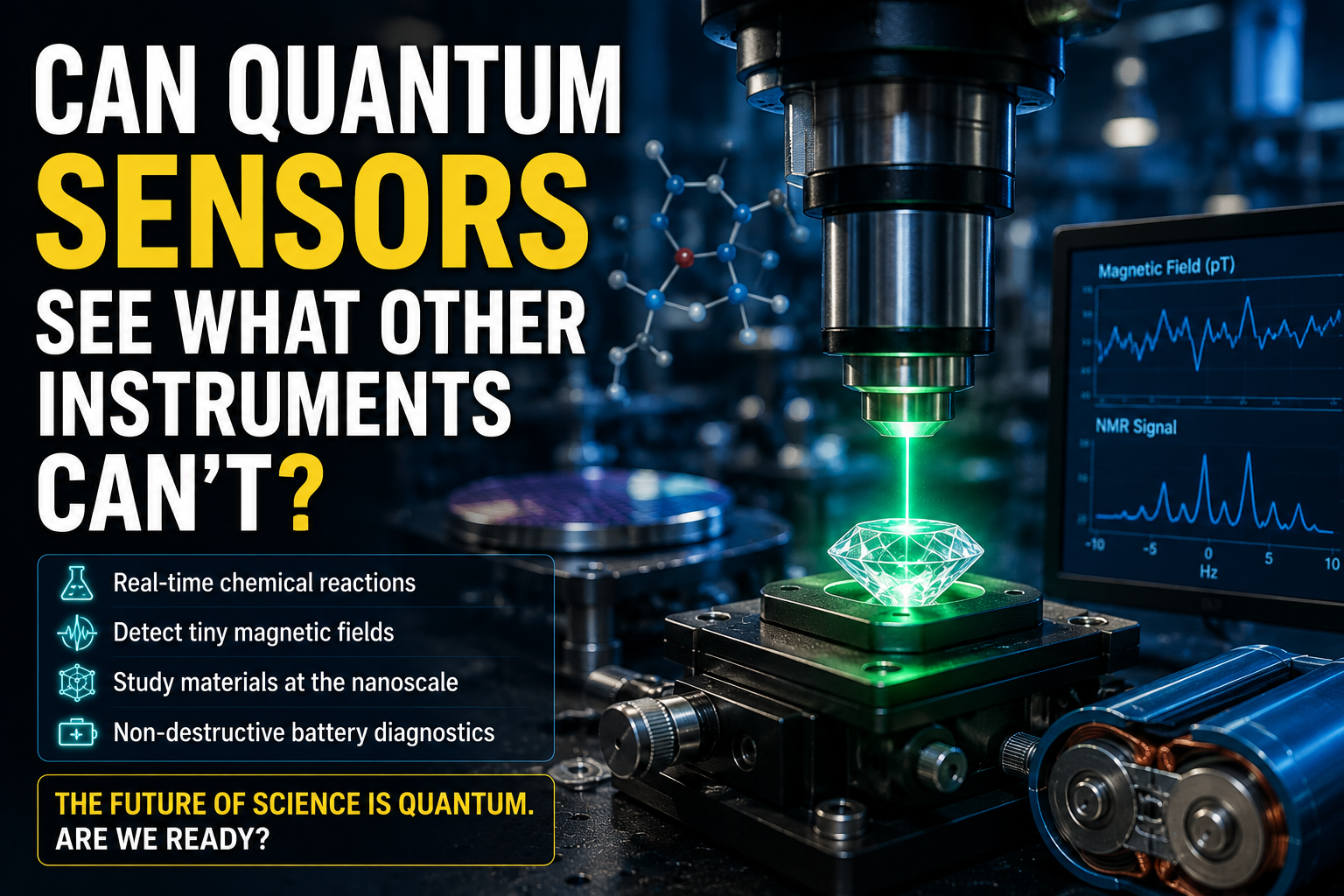
When illuminated with laser light and controlled using microwaves, NV centers become exceptionally sensitive detectors capable of measuring magnetic fields, electric fields, temperature, pressure, mechanical stress, and local chemical environments with nanometer-scale spatial resolution.
This combination of high sensitivity and atomic-scale resolution allows scientists to investigate phenomena that have traditionally been extremely difficult to observe directly.
For example, researchers can monitor chemical reactions while they are taking place instead of analyzing only the final products. Watching reactions evolve in real time provides valuable information about reaction pathways, intermediate compounds, catalytic mechanisms, and molecular transformations that are often invisible using conventional analytical methods.
The review also highlights major advances in Nuclear Magnetic Resonance (NMR). Traditional NMR instruments often require relatively large sample volumes and powerful superconducting magnets. Quantum sensors have the potential to perform similar measurements on microscopic samples, making it possible to analyze extremely small quantities of material or even individual microscopic structures.
Another important application involves detecting Free Radicals. These highly reactive molecules participate in many biological and chemical processes, including aging, inflammation, oxidative stress, metabolism, and disease development. Because free radicals typically exist for only very short periods, they have historically been difficult to study. Quantum sensors now provide researchers with new tools to detect and monitor these transient molecules with unprecedented sensitivity.
Battery research represents another rapidly growing application. Instead of opening batteries after failure to investigate internal damage, quantum sensors allow researchers to observe electrochemical processes while batteries are operating. Scientists can monitor ion transport, current distributions, magnetic field changes, and chemical degradation in real time without damaging the device. This capability could accelerate the development of safer, longer-lasting, and higher-performance batteries for electric vehicles and renewable energy storage.
In materials science, quantum sensors are becoming valuable tools for studying magnetic materials, superconductors, phase transitions, nanostructures, semiconductor devices, and quantum materials. Their ability to produce nanoscale maps of magnetic and electrical properties provides researchers with insights that were previously impossible using conventional techniques.
Why It Matters
Quantum sensing demonstrates that quantum technologies can create practical scientific tools long before fully fault-tolerant quantum computers become widely available.
Its impact extends across multiple scientific disciplines.
In chemistry, researchers can gain a deeper understanding of reaction mechanisms and molecular behavior.
In materials science, quantum sensors provide new methods for designing stronger, lighter, and more efficient materials.
In battery research, they enable non-destructive diagnostics that can improve energy storage technologies.
In biology and medicine, quantum sensors may eventually support highly sensitive molecular imaging, improved disease diagnostics, and better understanding of biological processes occurring inside living cells.
Because many quantum sensing platforms already operate outside highly specialized quantum computing laboratories, they are progressing steadily toward commercial instruments. Universities, research laboratories, medical facilities, and industrial manufacturers could all benefit from these technologies within the coming years.
More broadly, quantum sensing illustrates that the quantum revolution is not limited to faster computers. It is also creating entirely new ways of observing the physical world, allowing scientists to make measurements that were previously beyond the reach of experimental science.
What To Watch Next
Although quantum sensing has advanced rapidly, several technical challenges remain before widespread deployment becomes routine.
Researchers continue working to improve sensor sensitivity, measurement stability, spatial resolution, and long-term reliability while reducing system size, complexity, and manufacturing costs.
Future research will likely focus on integrating quantum sensors into portable scientific instruments, medical imaging systems, semiconductor manufacturing, environmental monitoring, industrial inspection, and autonomous technologies.
As these devices become smaller, cheaper, and easier to operate, quantum sensing may become one of the first quantum technologies to achieve widespread adoption across science, engineering, healthcare, and industry.