Can Black Holes Reshape Quantum Information?
Black holes are among the most mysterious objects in the universe. They are famous for their immense gravity, capable of trapping everything that crosses their event horizon, including light itself. However, modern quantum physics suggests that black holes may influence something even more fundamental than matter and energy: quantum information. This raises one of the biggest questions in theoretical physics—what happens to quantum information when it encounters a black hole?
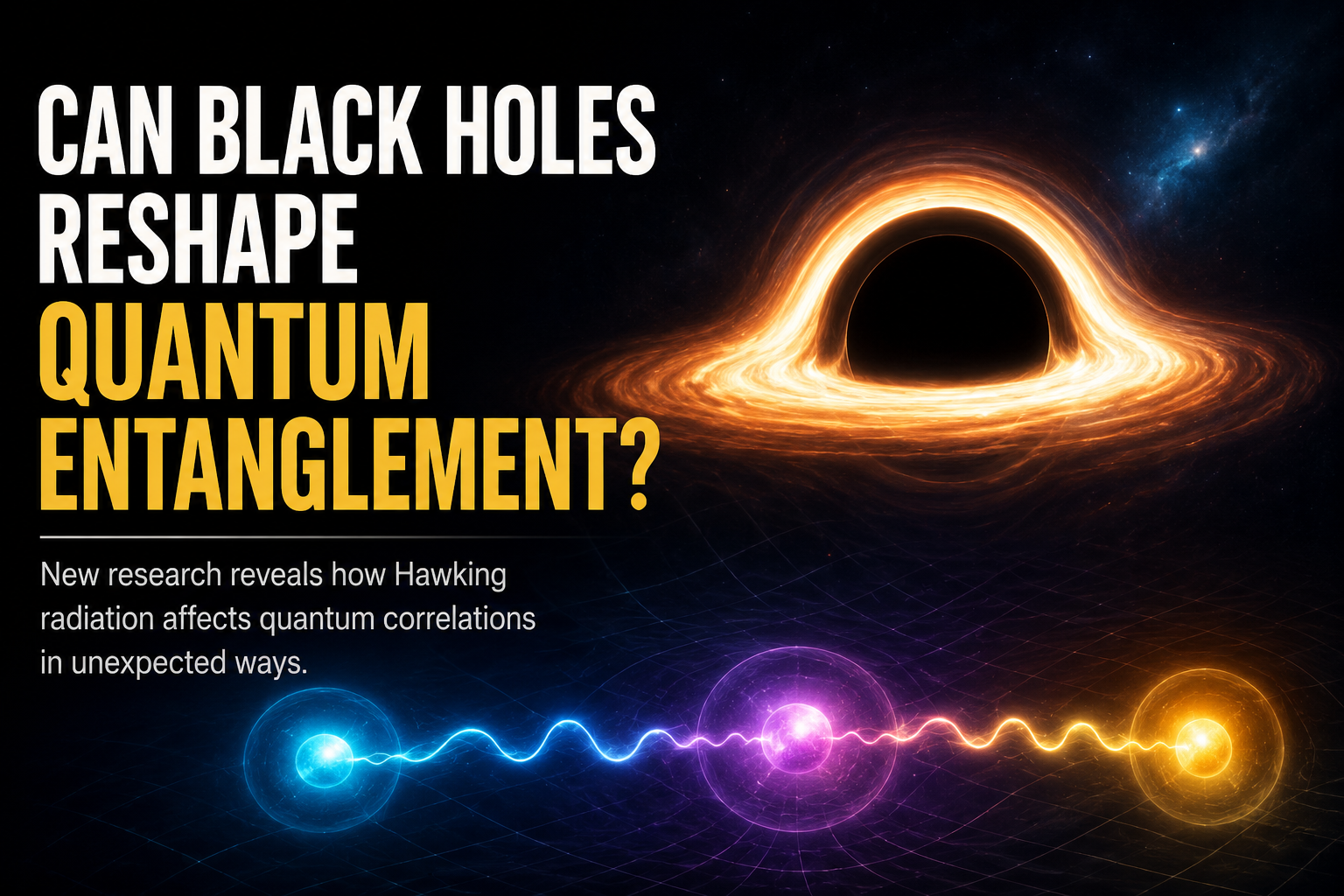
A new theoretical study investigates this question by examining how multipartite quantum correlations evolve near a black hole. Rather than finding that Hawking radiation simply destroys quantum information, the researchers show that it redistributes quantum correlations in a highly structured way. Even more surprisingly, the strongest quantum effects do not occur exactly at the event horizon, but within a surrounding region known as the Quantum Atmosphere. These findings provide new insights into the long-standing black hole information paradox and bring scientists one step closer to understanding how gravity and quantum mechanics may ultimately be unified.
Key Takeaways
* Hawking radiation does not simply erase quantum information but redistributes it among different regions of spacetime.
* The strongest changes in quantum correlations occur inside the Quantum Atmosphere, a region outside the event horizon.
* Multipartite quantum entanglement survives much better than quantum nonlocality under strong gravitational effects.
* The study strengthens the growing evidence that the Quantum Atmosphere plays a central role in black hole physics.
* The findings contribute to ongoing efforts to resolve the black hole information paradox and develop a consistent theory of quantum gravity.
The Context
For decades, physicists have struggled to reconcile two remarkably successful theories of nature. Quantum mechanics accurately describes the microscopic world of atoms and elementary particles, while Einstein's general theory of relativity explains gravity, spacetime, stars, and galaxies. Although each theory has been extraordinarily successful within its own domain, combining them into a single framework remains one of the greatest unsolved challenges in physics.
Black holes provide one of the few natural environments where both quantum mechanics and gravity become equally important. In 1975, Stephen Hawking revolutionized physics by demonstrating that black holes are not completely black. Instead, quantum effects near the event horizon cause them to emit thermal radiation, now known as Hawking radiation. Because this radiation appears to carry very little information about the matter that originally formed the black hole, it gave rise to the famous black hole information paradox: if black holes eventually evaporate, does the quantum information they contain disappear forever?
Since quantum mechanics requires information to be fundamentally preserved, resolving this paradox has become one of the central goals of theoretical physics. Recent research has increasingly focused on understanding not whether information disappears, but how quantum information changes, evolves, and redistributes itself under extreme gravitational conditions.
At the same time, a growing body of research has introduced the concept of the Quantum Atmosphere—a region extending outside the event horizon where many quantum processes responsible for Hawking radiation may actually originate. This idea challenges the traditional assumption that the event horizon itself is the primary location where Hawking radiation is generated.
The Main Idea
To investigate these questions, the researchers developed a theoretical model consisting of three entangled quantum particles. This multipartite system provides a much richer and more realistic description than the two-particle models commonly used in earlier studies.
Within the model, one observer remains safely far from the black hole while two additional observers gradually approach the event horizon. As these observers experience increasingly strong gravitational fields and stronger local Hawking radiation, the researchers analyze how the shared quantum information evolves.
Instead of examining only one quantum property, the study simultaneously investigates three complementary measures that describe different aspects of quantum correlations.
The first measure is Quantum State Texture, which characterizes how the internal structure of a quantum state changes as it interacts with curved spacetime.
The second measure is Genuine Multipartite Entanglement, which quantifies how strongly all three particles remain entangled together as a single quantum system rather than as independent pairs.
The third measure is Quantum Nonlocality, which determines whether the observed quantum correlations exceed the limits allowed by any classical physical theory through violations of Bell inequalities.
By comparing all three quantities simultaneously, the researchers obtain one of the most complete pictures yet of how multipartite quantum information behaves near black holes.
The results reveal that Hawking radiation does not simply weaken or erase quantum correlations. Instead, it redistributes them between regions that remain accessible to observers and regions hidden by the black hole. This redistribution suggests that quantum information changes its location and structure rather than disappearing entirely.
Perhaps the most striking result concerns where these changes occur.
All three independent quantum measures reach their strongest changes within nearly the same region outside the event horizon. This region corresponds precisely to the Quantum Atmosphere, providing strong theoretical evidence that it represents the physical location where Hawking radiation interacts most strongly with quantum systems.
As the local Hawking temperature increases, these characteristic regions gradually move farther away from the event horizon while remaining confined within the Quantum Atmosphere. This consistent behavior across multiple quantum measures strongly supports the hypothesis that the Quantum Atmosphere plays a fundamental role in black hole quantum physics.
The study also reveals important differences between various quantum resources. Genuine multipartite entanglement remains surprisingly robust even under increasingly strong gravitational effects. In contrast, quantum nonlocality deteriorates much more rapidly, indicating that not all quantum resources possess the same resilience in curved spacetime.
Why It Matters
This research has implications that extend far beyond black hole physics.
First, it provides new theoretical evidence that quantum information is preserved through redistribution rather than complete destruction. This represents an important step toward resolving the black hole information paradox while maintaining one of the central principles of quantum mechanics—that information cannot fundamentally disappear.
Second, the work strengthens the emerging concept of the Quantum Atmosphere as an essential component of black hole physics. Rather than viewing Hawking radiation as originating exactly at the event horizon, future theoretical models may increasingly treat the surrounding atmosphere as the region where quantum processes are physically generated.
Third, understanding how multipartite quantum systems evolve under strong gravitational fields contributes directly to quantum information science. The behavior of entanglement, quantum correlations, and nonlocality under extreme conditions provides valuable insights for quantum communication, quantum error correction, distributed quantum computing, and the development of more robust quantum technologies.
Finally, this research contributes to one of the ultimate goals of modern theoretical physics: developing a complete theory of quantum gravity that successfully combines quantum mechanics with Einstein's theory of general relativity into a unified description of nature.
What To Watch Next
Although the present work provides significant theoretical advances, many important questions remain unanswered.
Future studies are expected to investigate whether similar quantum behavior occurs around rotating Kerr black holes and electrically charged Reissner–Nordström black holes, whose spacetime geometries are considerably more complex than the Schwarzschild model examined here.
Researchers also hope to explore whether the predictions associated with the Quantum Atmosphere can be tested indirectly using quantum simulators, analogue gravity experiments, or future laboratory systems that reproduce Hawking-like radiation.
Another important direction will be extending the analysis to larger multipartite quantum systems, allowing scientists to understand how increasingly complex quantum networks behave in curved spacetime.
Ultimately, continued research into quantum information near black holes may help answer one of physics' oldest questions: how do gravity and quantum mechanics fit together into a single fundamental theory describing our universe?