
Can Artificial Intelligence Detect Topological Quantum Phases from Just a Few Particles?
For decades, physicists believed that identifying a topological quantum phase required measuring an entire quantum system. Unlike ordinary phases of matter, such as solids or liquids, topological phases cannot be recognized simply by examining individual particles because their defining properties emerge from quantum correlations spread across the entire system. As quantum processors and quantum materials continue to grow in size and complexity, performing these global measurements becomes increasingly difficult, expensive, and sometimes impractical.
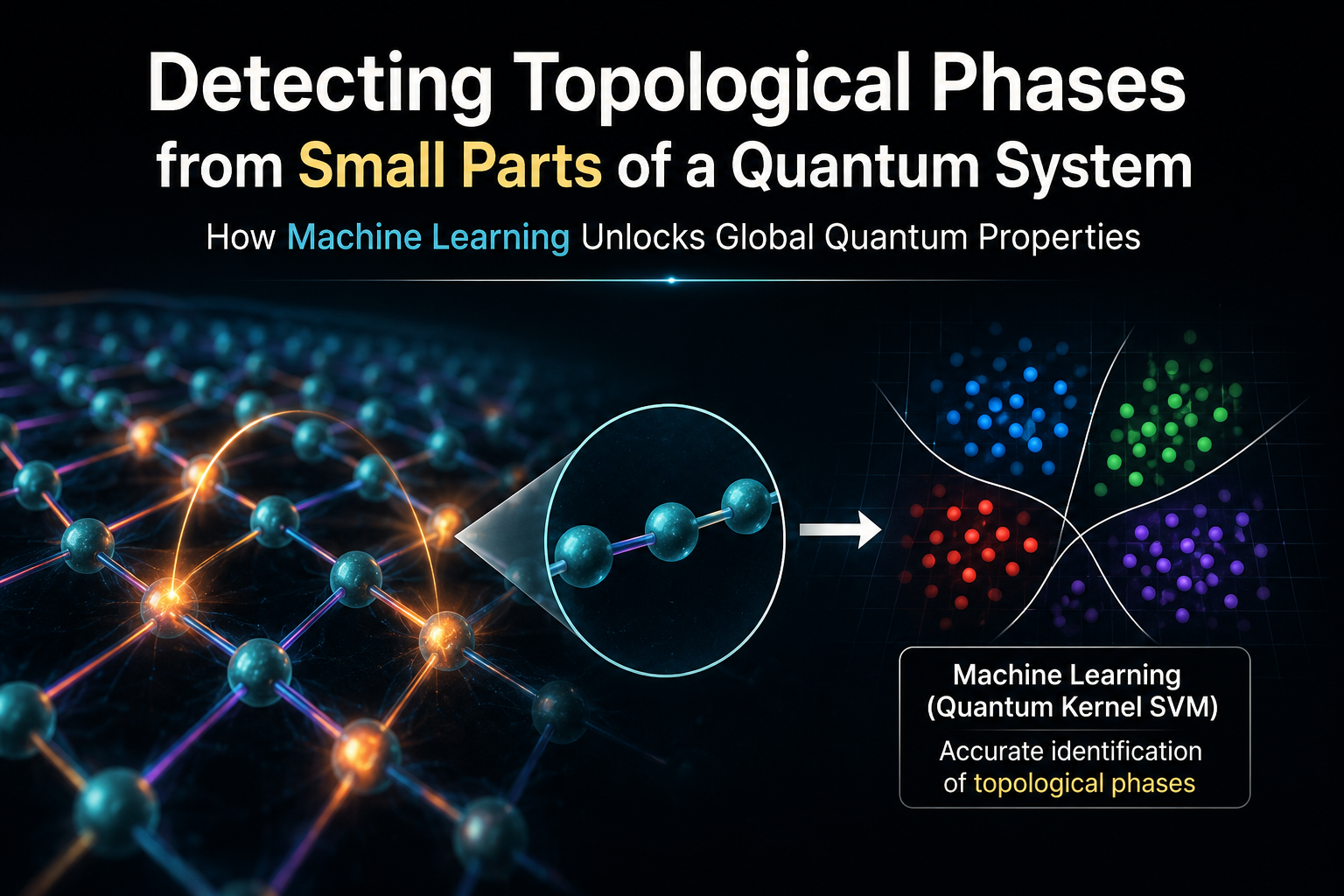
A new study challenges this long-standing assumption. Researchers demonstrate that artificial intelligence can accurately identify topological quantum phases using information from only a tiny fraction of the quantum system. By combining local quantum measurements with machine learning, the researchers show that global quantum behavior can often be inferred from surprisingly limited data. This discovery could significantly simplify future quantum experiments while opening new opportunities for quantum computing, quantum materials research, and automated scientific discovery.
Key Takeaways
* Researchers developed a machine learning approach capable of identifying topological quantum phases using measurements from only a few particles instead of an entire quantum system.
* The method relies on reduced density matrices that capture local quantum information and analyzes them using a Support Vector Machine with a quantum kernel.
* The trained model successfully generalized to larger quantum systems than those used during training, indicating that it learned underlying physical principles rather than memorizing examples.
* The approach could dramatically reduce the number of measurements required in quantum experiments, making the characterization of complex quantum materials faster and more practical.
* This research highlights the growing role of artificial intelligence as a scientific tool for discovering hidden quantum properties that are difficult to identify using conventional methods.
The Context
Understanding different phases of matter is one of the central goals of condensed matter physics and quantum information science. While familiar phases such as solids, liquids, and gases are identified through local properties like density or crystal structure, topological phases represent an entirely different class of matter.
The defining characteristics of a topological phase do not depend on individual atoms or particles. Instead, they arise from the collective organization of quantum states across the entire system. A useful analogy is a knot tied in a rope. The rope may be stretched, bent, or twisted without changing the knot itself. Only cutting or untying the rope changes its topology. Similarly, topological quantum phases remain stable even when a material experiences small imperfections or environmental noise.
This robustness has made topological phases one of the most promising foundations for fault-tolerant quantum computing. Because quantum information stored in topological states is naturally protected against many types of errors, these materials could enable far more reliable quantum computers.
However, identifying topological phases has traditionally required complex global measurements that become increasingly difficult as quantum systems grow larger. Finding simpler methods to recognize these phases has therefore become an important research direction in both quantum physics and quantum computing.
The Main Idea
The researchers explored whether machine learning could identify topological quantum phases using only local information rather than measurements of an entire quantum system.
Instead of collecting complete quantum data, they extracted Reduced Density Matrices that describe only small groups of neighboring particles. Although these reduced descriptions contain only a fraction of the system's information, they still preserve important local quantum correlations.
These local measurements were then analyzed using a Support Vector Machine equipped with a Quantum Kernel. Rather than relying on manually designed physical rules, the algorithm learned to recognize subtle quantum patterns hidden within the local measurements.
The results were remarkable. The model accurately distinguished different topological phases using information obtained from only one to four neighboring particles. Despite observing only a tiny portion of the system, the algorithm successfully inferred the global quantum phase with high accuracy.
Even more impressively, models trained on relatively small quantum systems continued to perform well when applied to much larger systems. This demonstrates that the machine learning algorithm learned universal physical features of topological phases instead of simply memorizing the training examples.
These findings suggest that local quantum information contains much richer signatures of global quantum behavior than previously believed, especially when interpreted using modern artificial intelligence techniques.
Why It Matters
This research could fundamentally change how scientists investigate complex quantum systems.
Instead of performing expensive measurements across an entire quantum device, future experiments may only require a small number of carefully selected local measurements. Machine learning algorithms could then reconstruct the global quantum phase from these limited observations, reducing both experimental cost and computational complexity.
Such capabilities are particularly valuable as quantum processors continue to increase in size. Characterizing large quantum systems is becoming one of the major bottlenecks in quantum hardware development, and methods that reduce measurement requirements could accelerate progress across multiple fields.
Beyond quantum computing, the approach may also benefit the discovery of new quantum materials, studies of quantum phase transitions, quantum simulations of strongly interacting systems, and future quantum sensing technologies.
More broadly, this work illustrates how artificial intelligence is becoming an essential scientific instrument. Rather than serving only as a tool for analyzing data, machine learning is increasingly helping researchers uncover physical laws and hidden structures that would be extremely difficult to identify through conventional analytical methods alone.
What To Watch Next
Although the results are highly promising, several important challenges remain.
The current study focuses primarily on simulated one-dimensional quantum systems. Future research will investigate whether the same techniques can identify more complex topological phases in higher-dimensional materials, strongly correlated quantum systems, and experimental quantum hardware.
Researchers are also expected to compare different machine learning architectures, including deep neural networks, graph neural networks, and quantum neural networks, to determine whether they can further reduce the number of required measurements while improving classification accuracy.
Another important direction is integrating these algorithms directly into quantum processors, allowing artificial intelligence to monitor quantum devices in real time, automatically identify quantum phases, detect errors, and optimize experimental performance.
If these developments continue, machine learning may become an indispensable component of future quantum laboratories, enabling scientists to characterize increasingly complex quantum systems using only a small fraction of the measurements that are currently required.


